Reproduce the local Fourier quotient diagrams
Read the complete learner and formal proof. The reader retains LP0–LP10, every LP1–LP27 equation, three worked examples, six complete solutions and all three figures with their full captions. Return to the L011 local-annihilator receiver.
Exact original downloads
All eleven files below retain their original bytes. Keep the renderer, original proof, original README and licence at the root of a fresh scratch directory and the seven figure/geometry files in figures/.
- local-polynomial-annihilator-proof.md — 26956 bytes; SHA256
4272787FD760CC61926DBAF883B642DE902271507E4009F63E3864015867169C. - make_figures.py — 8171 bytes; SHA256
4583CA03AA65ED58D0FDA7315E74EC83771F07EA8DBCD0BD22ABD249F0EB910A. - README-reproduce.md — 2309 bytes; SHA256
80C815D9C8E2F201BBE28B0A980CD3A151F823D57DB171816D22594B52FA262B. - LICENSE-ORIGINAL.txt — 549 bytes; SHA256
76B0CD8C9C2F0F37B7F6F13C08318093D4FFA5E3FFCE39333E77CA95375DA953. - geometry.json — 2469 bytes; SHA256
B0FA501D91C6270CDF015D976AAD896335C6CDDE00BAA57260D3C7DB75158407. - local-quotient-global-pole.png — 129997 bytes; SHA256
CF7226B6CB871F4B48DE1BE818DD59ADA652D0EAAF6F1317619812587A16630B. - local-quotient-global-pole.svg — 73912 bytes; SHA256
896AD6DD9F9D82517E4ADCD9C58E8A2C1C16F7A1B52A5016D682024B95D61D56. - moments-to-local-quotient.png — 187089 bytes; SHA256
7C17663DC52A9B1AD7303C91A644DBC30623A20C23BD2B6F56531A348BF1587B. - moments-to-local-quotient.svg — 100322 bytes; SHA256
A1BBF53CCEDBFD4F47DA13528FE3AFCAFCA73B7CA66694B17E7A0A4AA67814D4. - root-circle-and-analytic-unit.png — 171091 bytes; SHA256
1107CCE748F676299CBF2008FC88E476495695394E7EF34A4E0658DF48FC25D3. - root-circle-and-analytic-unit.svg — 85949 bytes; SHA256
E254D859E843BCA9DC385B01FD21961BDDE3132E3FD9E36DE84B0C36FD969223.
Fresh reproduction
The unchanged renderer requires Python, NumPy and Matplotlib. Choose an empty output directory:
python -B -X utf8 make_figures.py --output fresh-figures
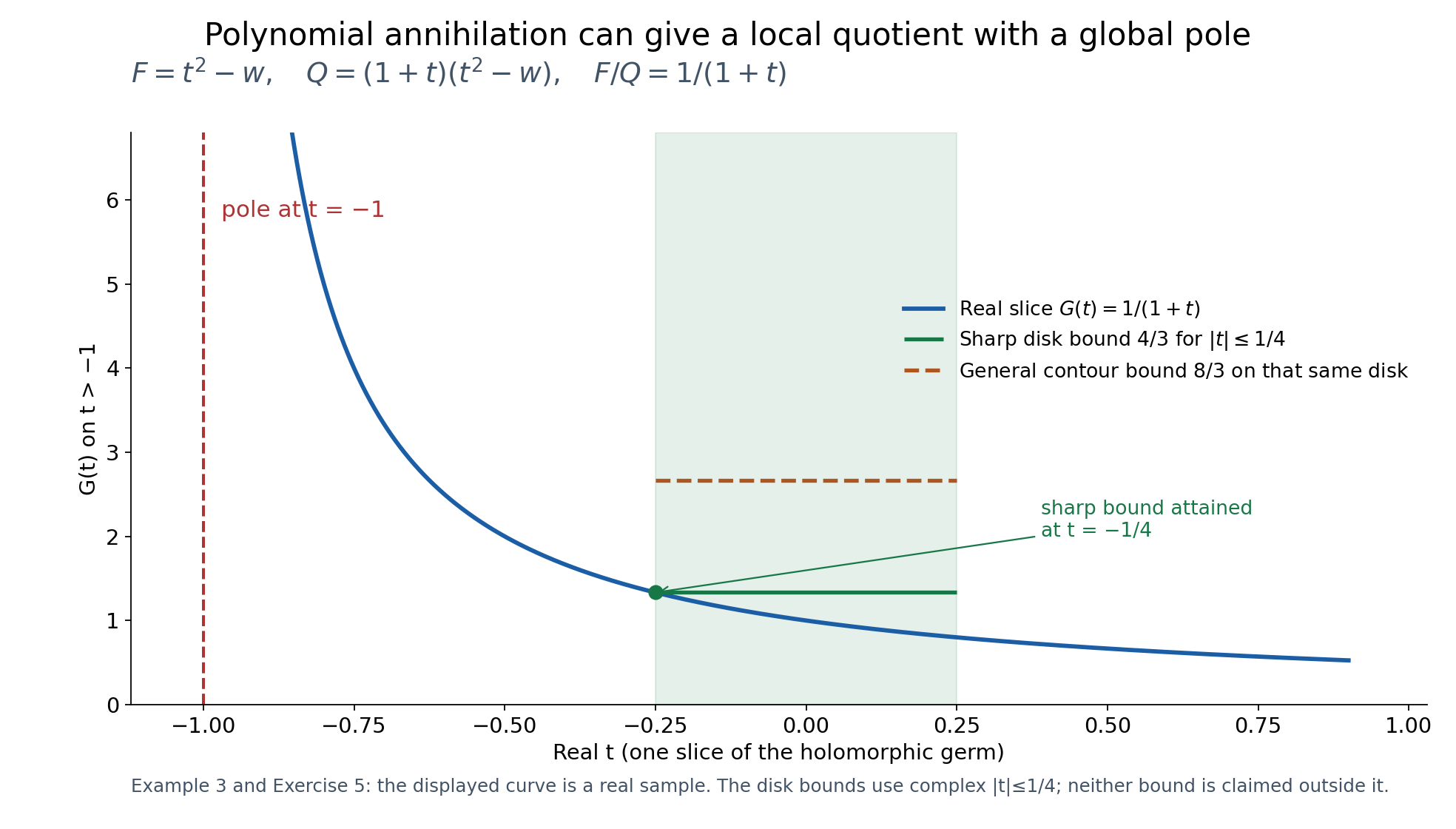
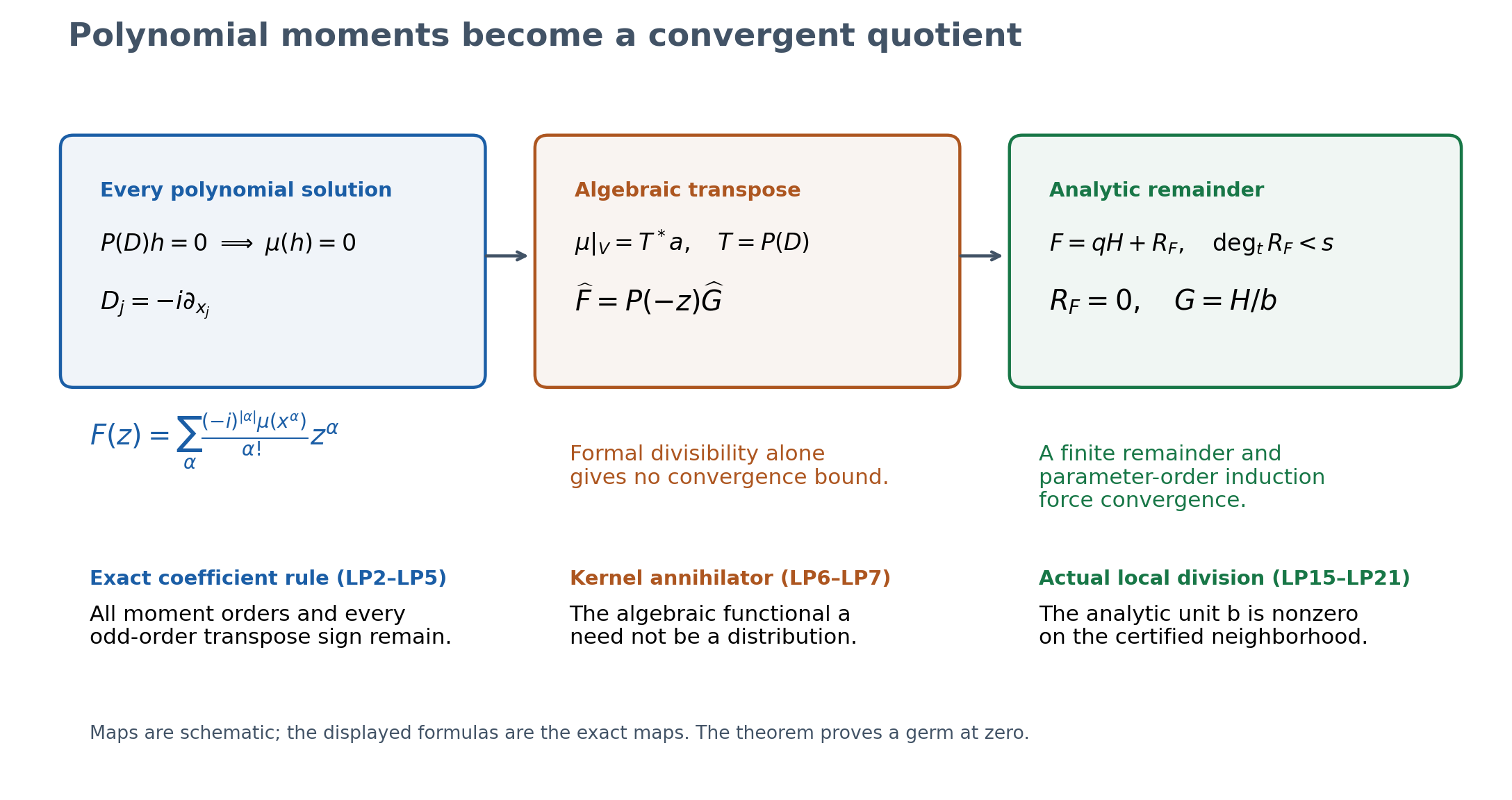
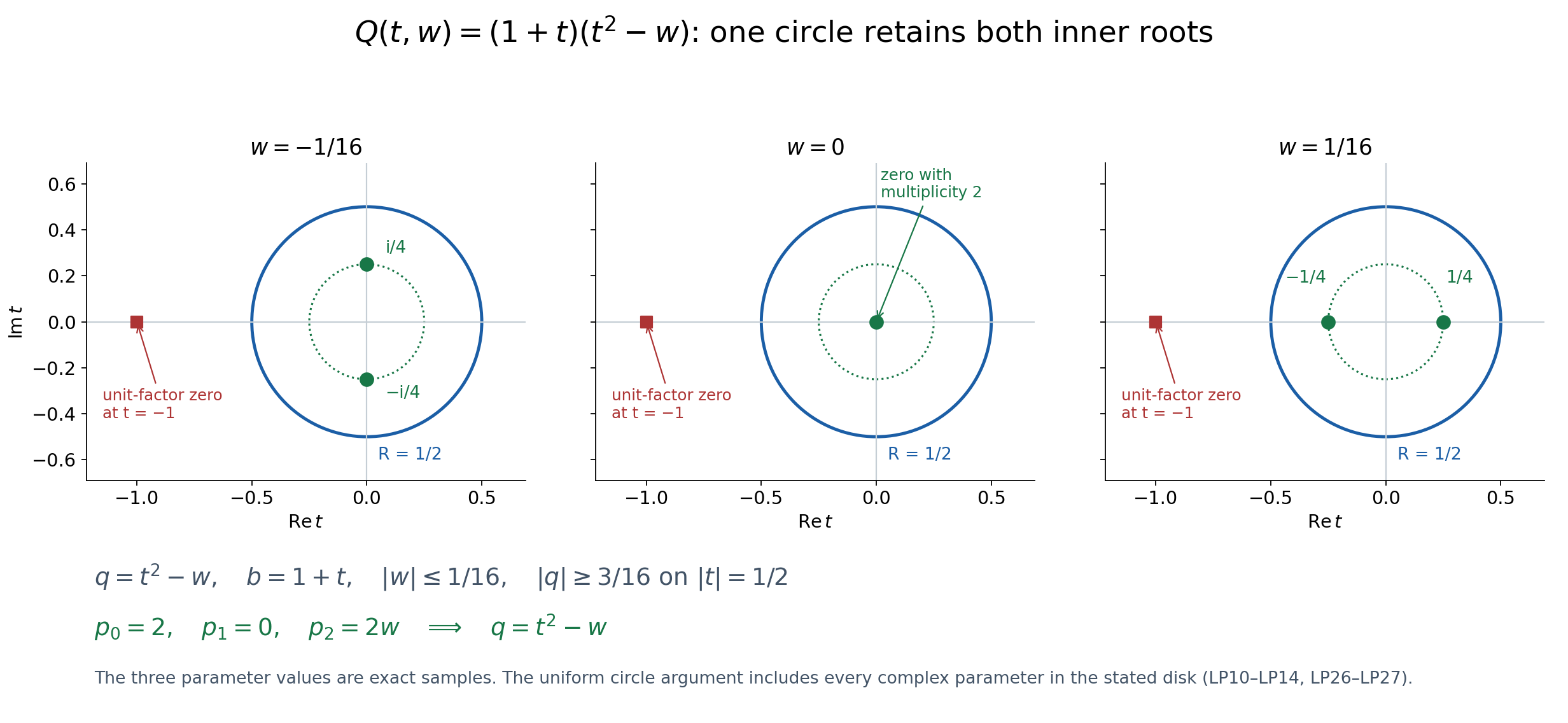
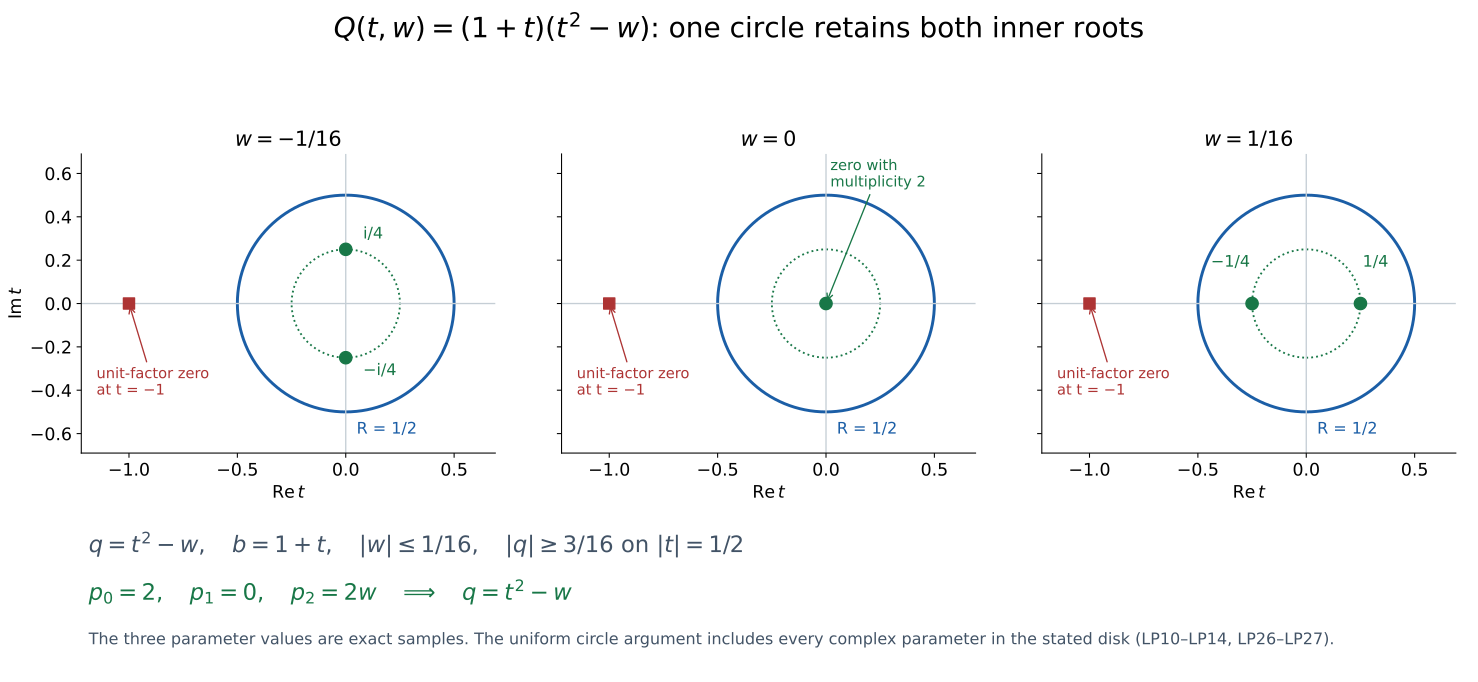
Compare all three PNGs, three SVGs and geometry.json with the supplied originals. The exact-map schematic keeps every phase, factorial and formal-transpose sign. The root diagram keeps the two inner roots with multiplicity, the extra root at −1, the contour radius 1/2 and inner radius 1/4. The final real slice retains the global pole and distinguishes the sharp complex-disk bound 4/3 from the general contour bound 8/3. Each complete caption states its proof locators and sample or schematic scope. Different software or fonts may change image bytes; the geometry states the exact mathematical objects.
Credits, terms and boundary
Original CC0 notice and Reader credits retain GPT-6.1 Sol (OpenAI), Ultra and the human mathematical credit to Hörmander’s polynomial/exponential-polynomial annihilator context. The original LP10 paragraph retains all exact programme locators. L011 retains Malgrange’s density source. Source credit is not a proof closure or a licence for book expression. Matplotlib, DejaVu Sans and the existing MathJax reader retain their applicable component terms; no font binary is included.
The theorem proves a convergent quotient germ near zero. An entire quotient, compact inverse and ordinary support-hull alternative remain separately explained in L122. L011’s continuation needs every irreducible factor to vanish at zero. Lower foundations, compact singular-support hulls, general topology and course closure retain their stated scope.