Reproduce the Tangent cones that permit an imaginary push
These original drawings accompany Tangent cones that permit an imaginary push. The complete mathematical proof, all worked examples and complete solutions remain in that reader.
Download the unchanged original files
Keep render_figures.py at the root of an empty scratch directory and the PNG, SVG and geometry files in figures/. The two unchanged Markdown sources and CREDITS.txt/LICENSE.txt stay at the package root; they are downloads and are not generated by the renderer. The renderer creates figures/ during a fresh run.
- render_figures.py — 7123 bytes; SHA-256
2EE7067C1F1DF1C656C88D543A2828A65EC4E583B0480440C60B5705EFAC9734. - crossing-cone-variation.png — 132398 bytes; SHA-256
9D24E1113D7ED071BC56160A4D0AD6F540D81E8E2EBF6B89F3F11C2FEAB5381E. - crossing-cone-variation.svg — 138447 bytes; SHA-256
8218254786FCACB85FA129CE0CF5DD6407FFB9D94F50B29A8E0D0B9AE1F3A920. - geometry.json — 1595 bytes; SHA-256
49800A69B57F4FC22B05351F88EF9A2649792CE3E79206E9E535EE3FA220C014. - wave-imaginary-exclusion.png — 203269 bytes; SHA-256
E955DE8252BF48AABBFA121B792FD231E471E32973254C81585DFD3080818162. - wave-imaginary-exclusion.svg — 107225 bytes; SHA-256
18BFC6C66B339F79CBC1394D1BF0D39A6D665FA1C8BB113938CB01A9A11232EA. - local-cone-lesson.md — 17544 bytes; SHA-256
BD25B10CBD68B297700EF9C8A693774AC8564CA6C1C002FCD7B2C34A4AA784D2. - local-cone-proof.md — 22683 bytes; SHA-256
6384F5E41C3804352C024DB26DE57D21D8426EA0641894D5608848238F46BAD7. - LICENSE.txt — 449 bytes; SHA-256
48B9517A889A297BB0B328B30295E108213CC8BCEDD756A9D7CD6C2A6E795EB6. - CREDITS.txt — 1709 bytes; SHA-256
D02713CB07E67A0F4254D962652163DAD5716EC77F6D8DF521250929BE8FBBD2.
Run the renderer
The unchanged program requires Python, NumPy and Matplotlib. In the scratch directory run:
python -X utf8 render_figures.py
It writes the supplied PNG, SVG and exact geometry files. A fresh replay with Python 3.13.9, NumPy 2.4.4 and Matplotlib 3.10.9, using Matplotlib’s bundled DejaVu Sans font, matched every renderer/figure file byte for byte and all decoded PNG RGBA pixels. No SVG date or identifier normalization was performed. Byte identity is qualified by that observed software and font environment; different versions may change rendering bytes. The geometry files specify the mathematical objects independently of rendering.
Check the mathematics and credits
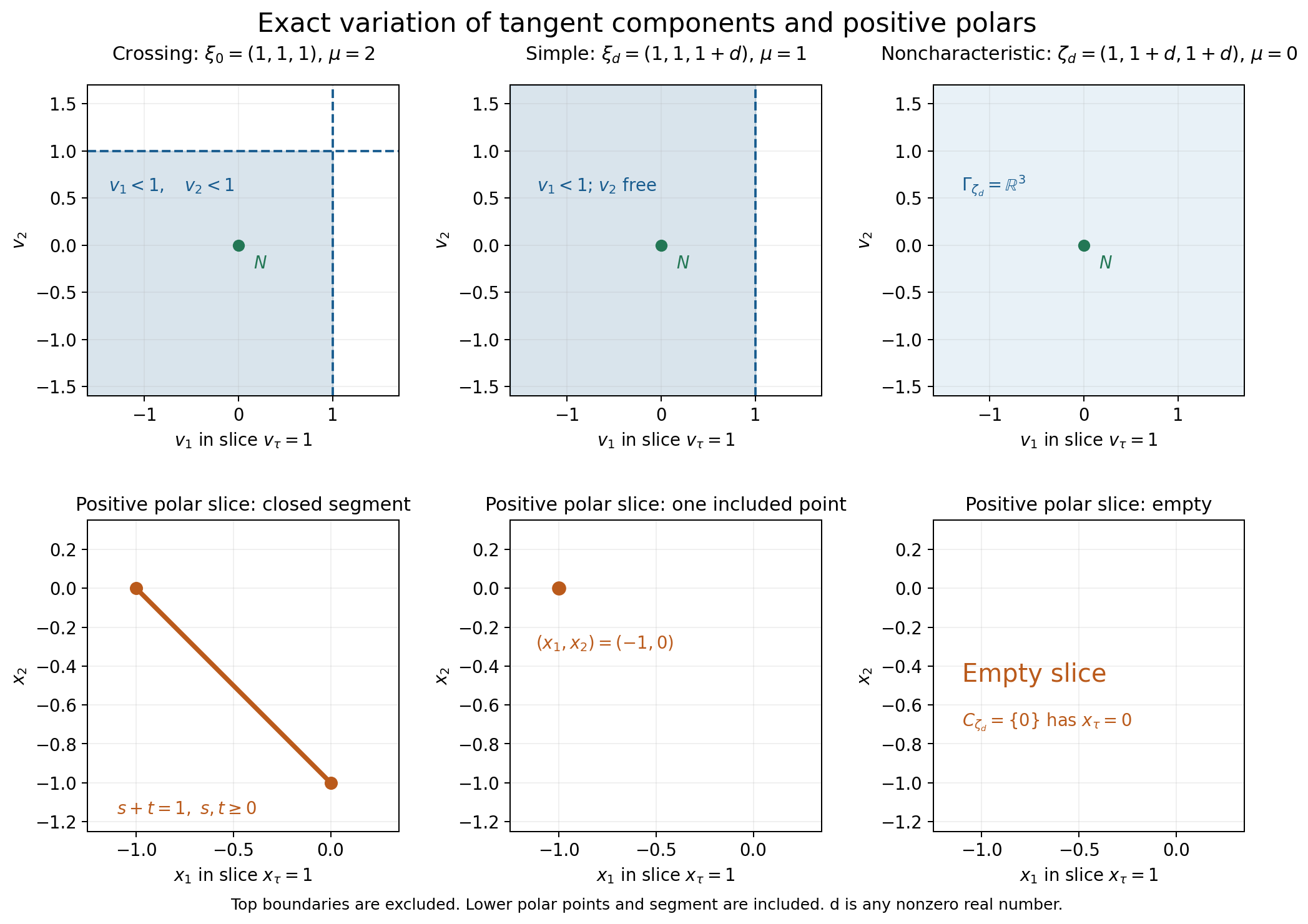
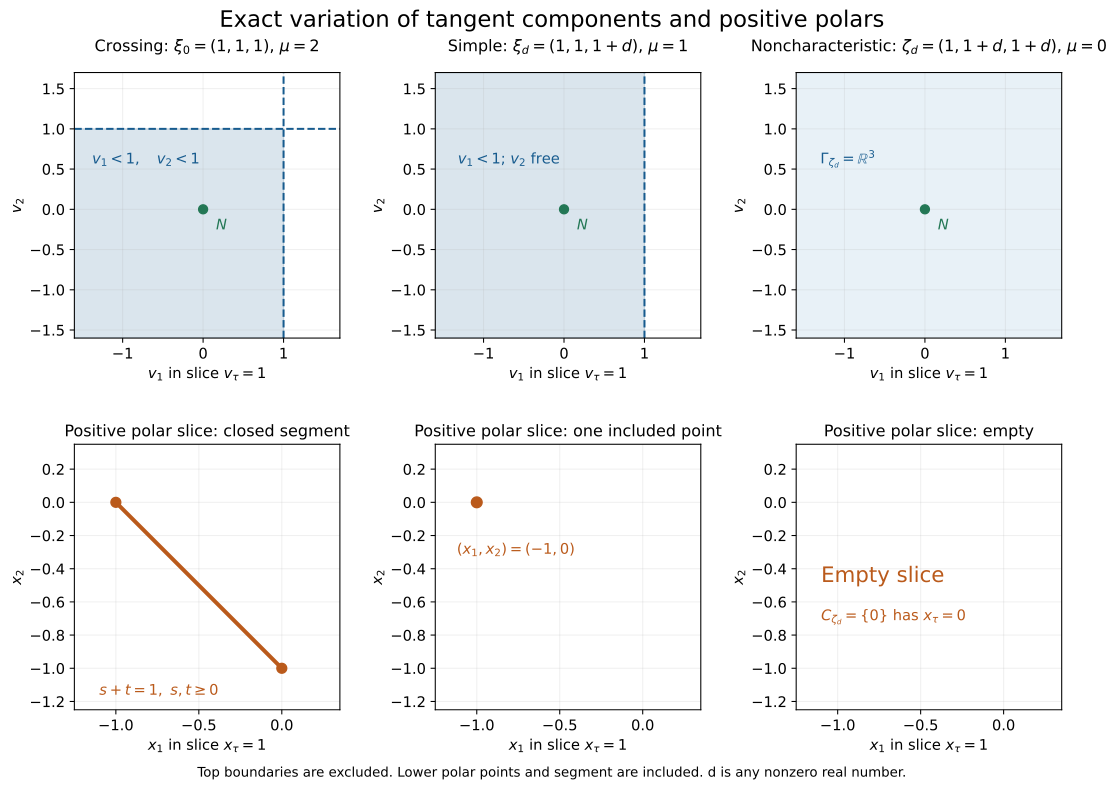
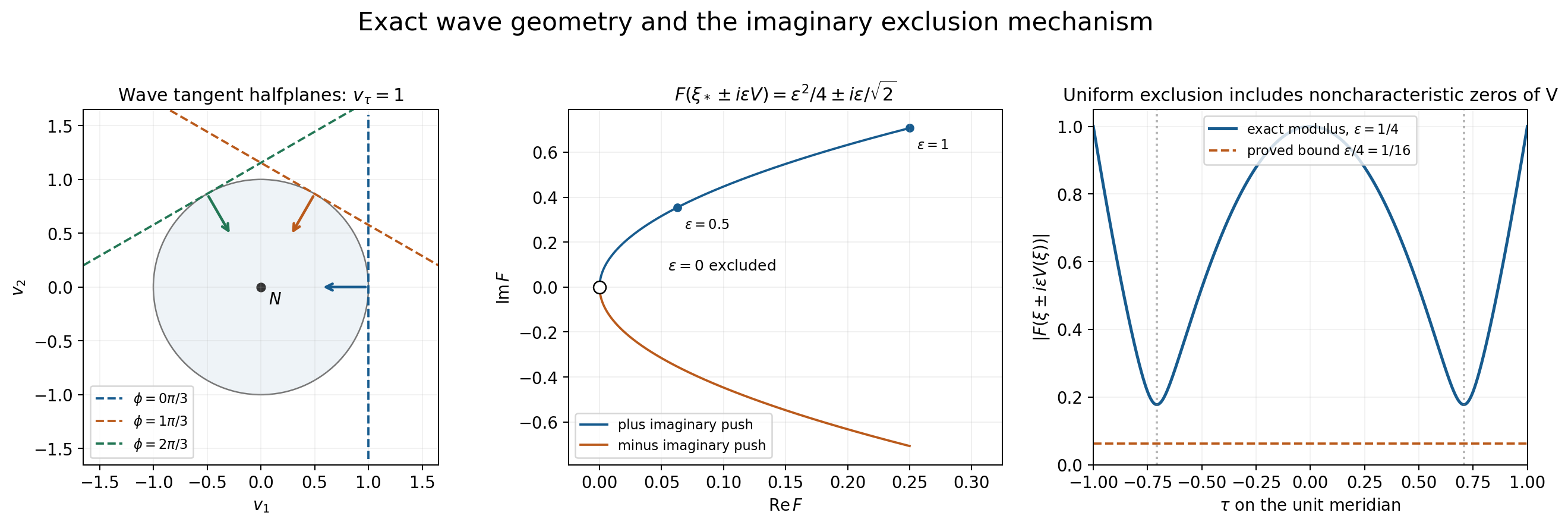
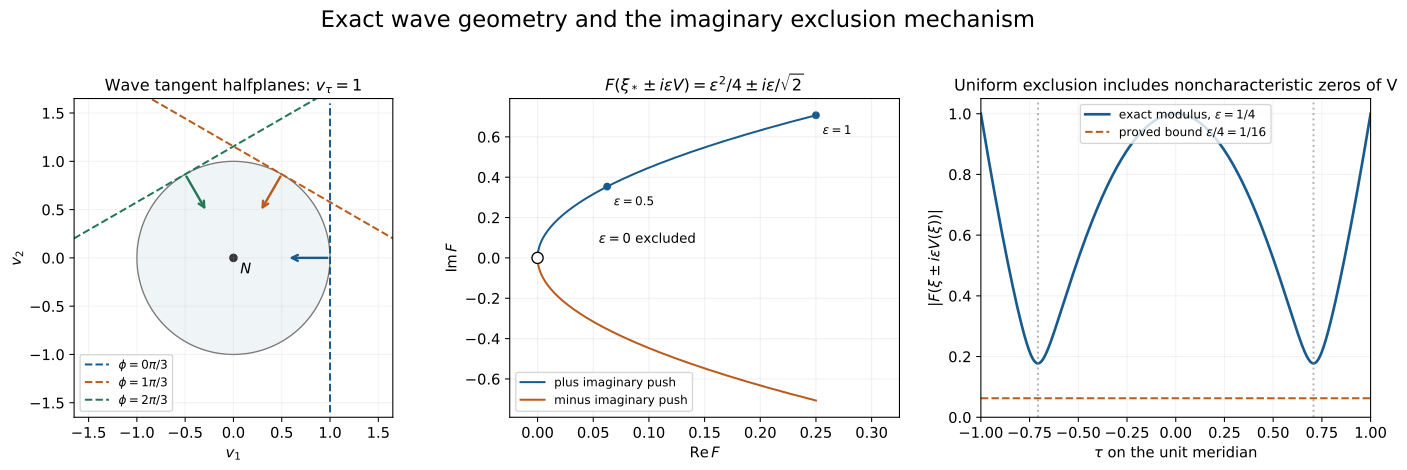
The first figure shows exact component slices vτ = 1 and positive-polar slices xτ = 1 for the crossing, simple and noncharacteristic points of (τ−η₁)(τ−η₂). Excluded cone boundaries are dashed; included polar points and segment are solid. The second shows exact rotating wave tangent halfplanes, both trajectories ε²/4 ± iε/√2 and the meridian modulus at ε = 1/4 with proved lower bound 1/16. These are slices and exact sampled functions, not general theorem proofs. Full captions, LC035-2–4 and learner E1–E3 give locators. The full formal proof follows the complete learner and all six solutions. The C1/D1 and D4 inputs, the general real analytic and microhyperbolic case, D5–D6 and the full C6–C8/component scope are not proved in the lesson.
CREDITS.txt gives every human source and locator. Original prose and figures are CC0; copyrighted references are comparison credits and are not imported.
The original renderer, scene/geometry and diagrams are GPT-6.1 Sol (OpenAI), Ultra work, October 2026, dedicated under CC0. Matplotlib and the bundled DejaVu Sans font retain their own component terms already included with this course. The native geometry is explanatory; the full proof establishes the theorem.