Reproduce the Support cones force reciprocal bounds
These original drawings accompany Support cones force reciprocal bounds. The complete mathematical proof, all worked examples and complete solutions remain in that reader.
Download the unchanged original files
Keep make_figures.py at the root of an empty scratch directory and the remaining files in figures/. The renderer creates figures/ during a fresh run.
- make_figures.py — 4912 bytes; SHA-256
2BC333EED0FBD68D0550B21749764AAE3435A4760ABD443974CC5503A5728AF8. - finite-truncation-error.png — 53606 bytes; SHA-256
B5A8CF0FE0F305EA6D2B2F15BDF1384EC9879101DFAB0E4E21260243CB480178. - finite-truncation-error.svg — 27989 bytes; SHA-256
CB05558AF18FD1842472B0C290C06033F4DED4F69EB0125A4BFEB522779586FC. - scene.json — 1147 bytes; SHA-256
953667A77C37346DC4CC1005647B1B83679F1069C5D6C3BC245F95B062EC0F0B. - translated-cone-and-kernel.png — 61788 bytes; SHA-256
364EC3F86F117521CC5943BABBE4001972B8FBD485A07A9B64862C0F092CF5E9. - translated-cone-and-kernel.svg — 35118 bytes; SHA-256
8D4C9FC5CA647DB38562CDFBEAE441CB34C8EA124FEECE4E115AF69EED64C178.
Run the renderer
The unchanged program requires Python, NumPy and Matplotlib. In the scratch directory run:
python -X utf8 make_figures.py
It writes the supplied PNG, SVG and exact geometry files. A fresh replay with Python 3.13.9, NumPy 2.4.4 and Matplotlib 3.10.9, using Matplotlib’s bundled DejaVu Sans font, matched every supplied file byte for byte and all decoded PNG RGBA pixels. No SVG date or identifier normalization was performed. Byte identity is qualified by that observed software and font environment; different versions may change rendering bytes. The geometry files specify the mathematical objects independently of rendering.
Check the mathematics and credits
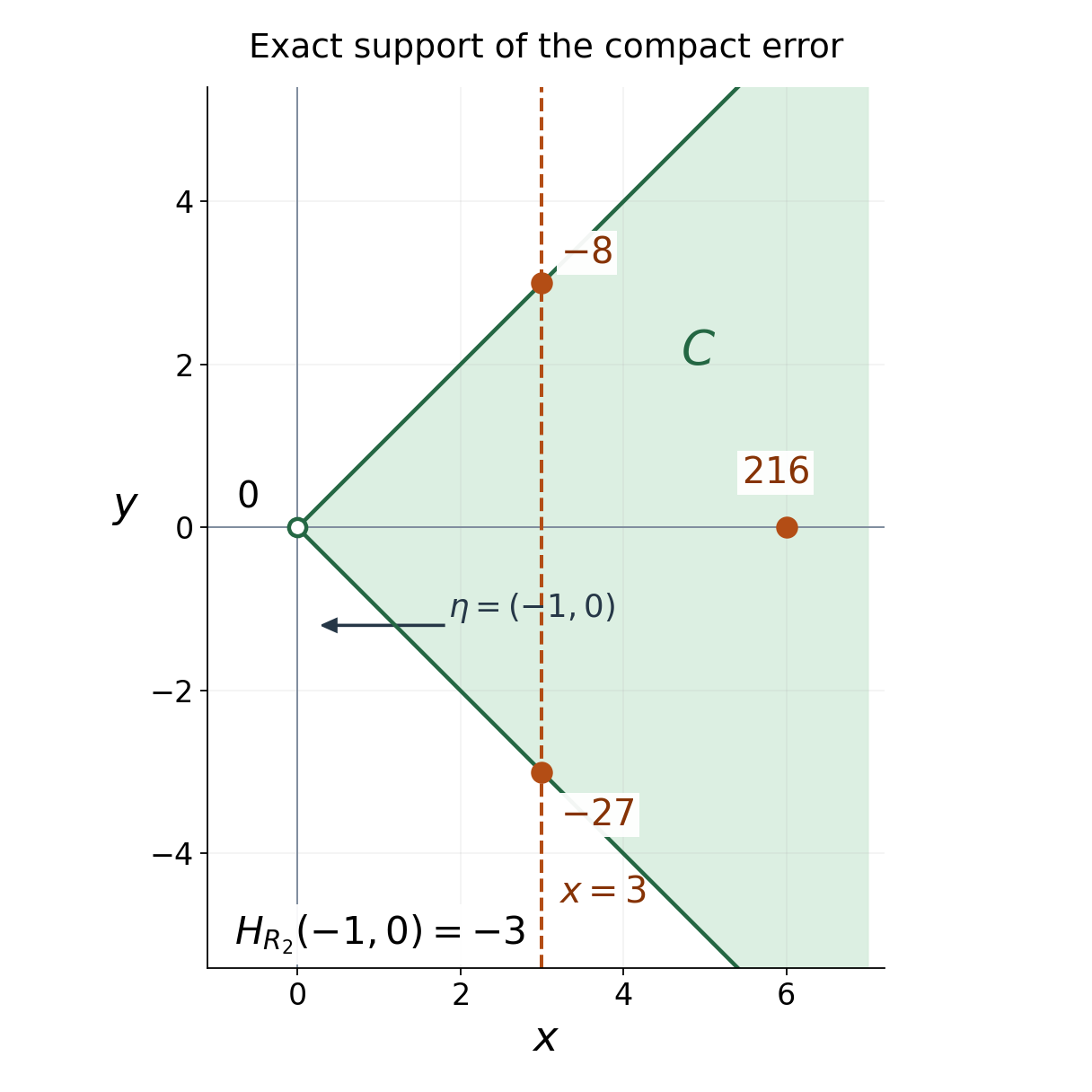
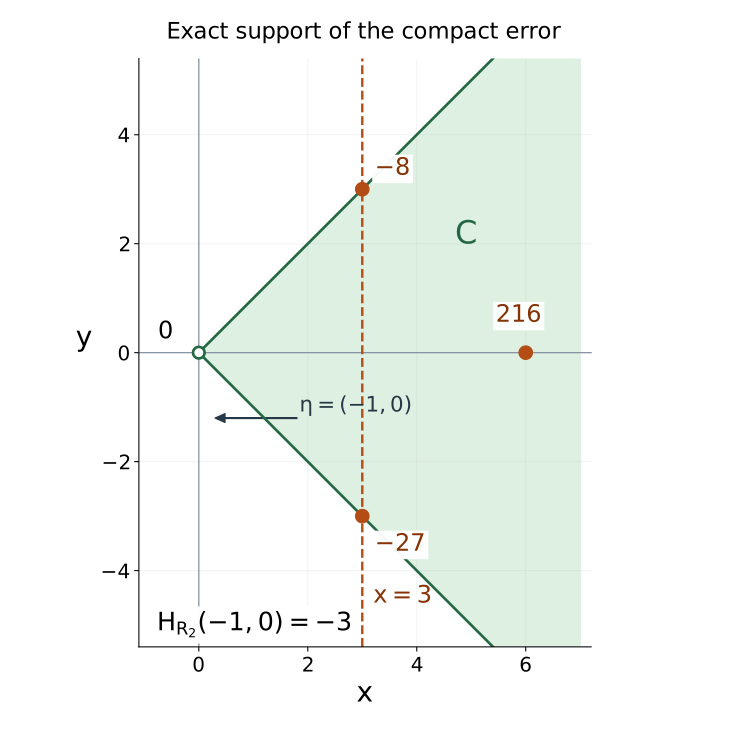
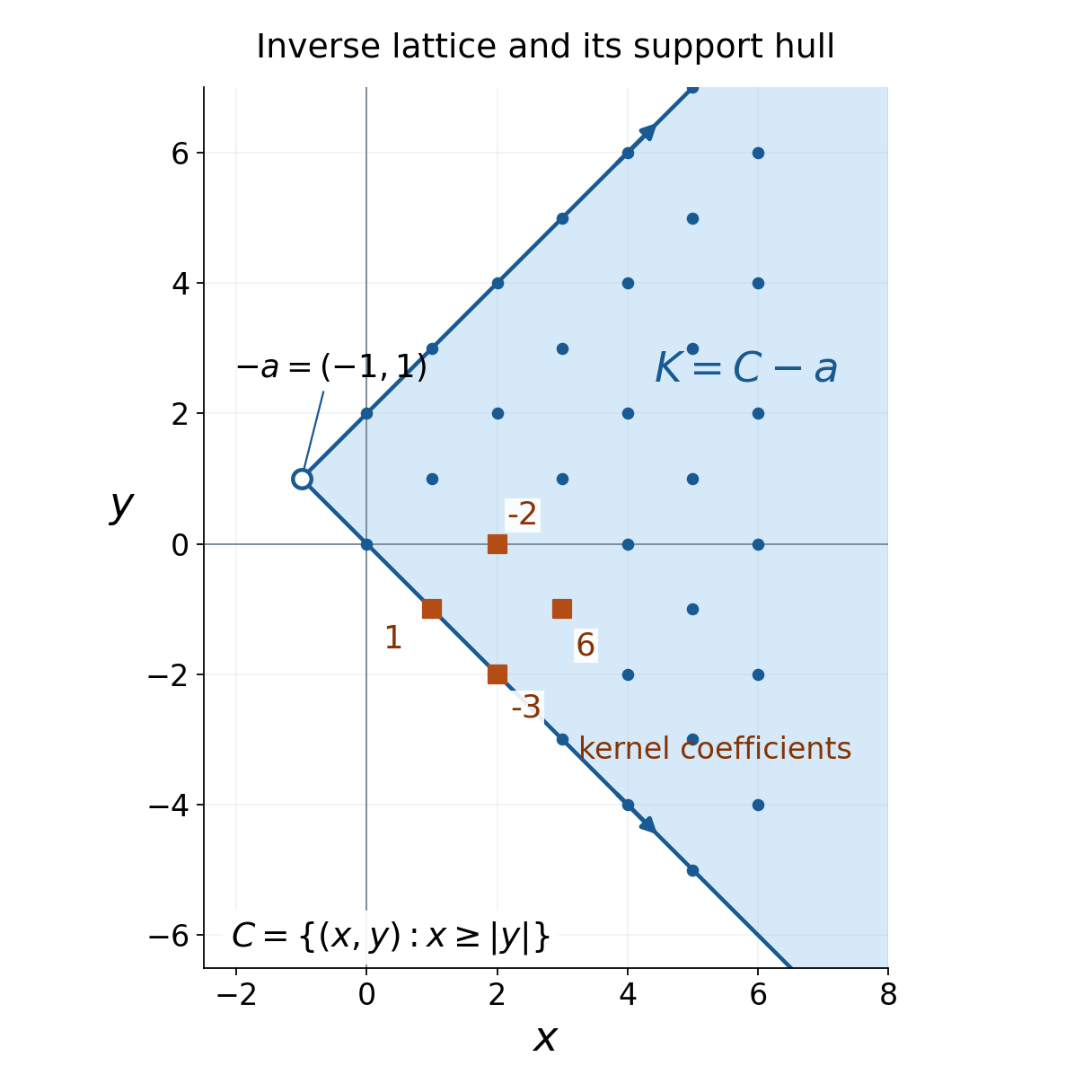
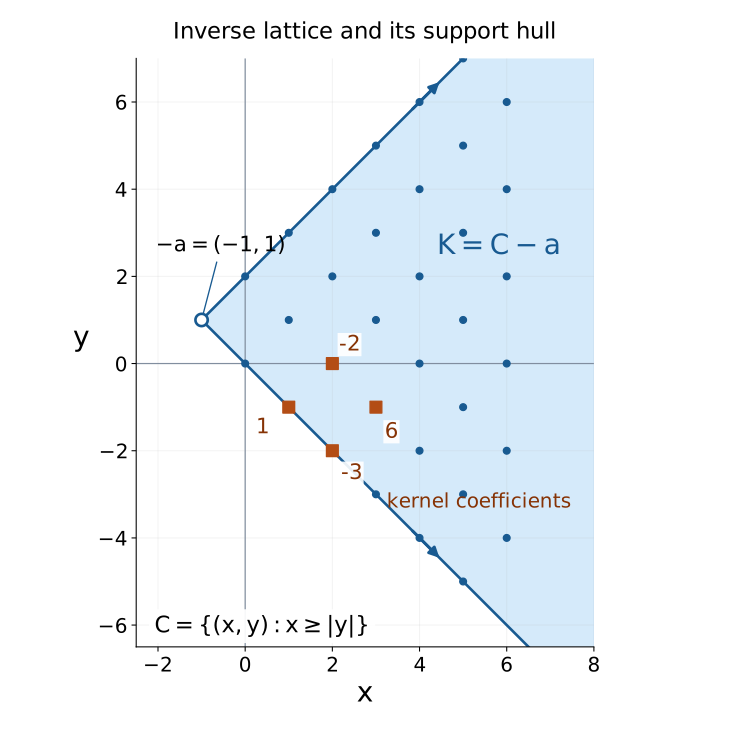
Figure 1 has exact vertex −a=(−1,1), directions v₁=(1,1), v₂=(1,−1), compact kernel coefficients 1, −2, −3, 6, and inverse hull x+1≥|y−1|. The displayed lattice is finite; the full inverse is unbounded. Figure 2 displays the exact three error atoms (3,3,−8), (3,−3,−27), (6,0,216) of F₂, with supporting line x=3. See Theorem 1.1, Example 6.1 and both complete captions. The theorem proves the general forward implication; the general converse remains separate.
The original renderer, scene/geometry and diagrams are GPT-6.1 Sol (OpenAI), Ultra work, October 2026, dedicated under CC0. Matplotlib and the bundled DejaVu Sans font retain their own component terms already included with this course. The native geometry is explanatory; the full proof establishes the theorem.