Positivity through a moving family of scalar probes
A nonnegative function of position and frequency need not give a nonnegative operator under left quantization. We construct a positive operator by testing the symbol against translated, modulated and dilated scalar probes. The construction works with an arbitrary Hilbert space as its coefficient space. Its accuracy comes from two separate facts: the probe has no odd moments, and its scale changes slowly across its frequency window. Keeping those facts separate also identifies the error when frequency and position derivatives have equal costs.
The Fourier convention is , with inverse coefficient , and . Fourier inversion and Plancherel were proved in Fourier transforms, finite spectra and convex separation. We use completeness of Banach spaces, the norm inequality and dominated convergence for Bochner integrals, scalar Lebesgue integration and Tonelli’s theorem, Taylor’s formula, smooth compact cutoffs, and the Hahn–Banach norm identity . The Banach-space completeness and Hahn–Banach steps needed below are in Banach estimates, quotient spaces and compact parameter arguments; Sections 17–21 of that chapter supply strong measurability, the full Banach-valued integral and convergence, both absolute Fubini orders, complete Hilbert-valued L2, the original monomial Schwartz entry and exact lattice cutoffs, with their original norms and factors. The scalar symbol estimates imported from Symbols, operators and Sobolev scales are Sections 1–8 of Symbols, operators and Sobolev scales, whose quantization and composition arguments use Quadratic Fourier multipliers at a moving scale, Sections 7–8 of Quadratic Fourier multipliers at a moving scale. We prove the necessary Banach and Hilbert space extensions below; no finite-dimensional approximation of an operator-valued symbol is assumed.
1. Banach coefficients and distributional duals
Let be a complex Banach space. The space consists of norm-smooth functions with finite seminorms All integrals defining their Fourier transforms are Bochner integrals. Integration by parts gives the usual derivative and coordinate identities, with convergence in the Banach norm. Fourier inversion follows by applying every , using scalar inversion, and using norm separation to identify the two Banach vectors. The scalar estimates for Fourier transformation in Schwartz seminorms give the corresponding norm estimates by the same argument. Completeness follows by taking the uniform limits of all derivatives on compact sets and then passing to each weighted bound in (P1).
Use the complex bilinear evaluation for Banach duality. For a reflexive , define with the topology of uniform convergence on bounded sets of test functions. Regular functions of polynomial growth act by integration of this bilinear pairing. This convention has the usual interpretation as continuous linear maps . Here is an explicit justification, which will also prevent an incorrect dual space from entering the transpose construction.
If is a functional in (P2), then is a bounded linear functional on . Reflexivity identifies it with a unique . An estimate implies , so is continuous. Conversely, suppose . Choose a smooth lattice partition , with supported strictly inside a fixed cube. Choose a larger cube of side and a cutoff , supported in its interior and equal to one on . Fourier expansion on that larger cube gives, for , The coefficients are those of on the cube centered at . We justify the periodic reconstruction used here. On the circle of period , with normalized measure , set This kernel is nonnegative and has integral one, since the exponentials are orthogonal. The geometric-sum formula bounds by away from multiples of . Hence its mass outside any fixed neighborhood of zero is . The product of these kernels in coordinates has integral one and the same concentration property: outside a small product neighborhood at least one coordinate is separated from zero, and integration in the other coordinates leaves unit mass. For a continuous periodic scalar function , split its convolution error into that neighborhood and its complement. Uniform continuity makes the first part arbitrarily small, and the second is bounded by times a mass tending to zero. Thus these product convolutions converge uniformly to .
If is smooth, periodic integration by parts with gives , so its Fourier series and every differentiated series converge absolutely and uniformly. Expanding the finite kernel sum shows that the product convolution has coefficients , where . These factors are bounded by one and tend to one for each fixed . Absolute convergence therefore makes the convolutions converge uniformly to the Fourier sum too. This identifies that sum with , and applying the same argument to each derivative gives smooth reconstruction.
For fixed , the function vanishes near the cube’s boundary and thus extends smoothly and periodically. Bochner integration by parts gives the same norm decay of its coefficients, so their series and all differentiated series converge absolutely in , uniformly on the cube. Applying every commutes with the coefficients and the sums; scalar reconstruction identifies each scalarized sum with . Hahn–Banach norm separation identifies the Banach vectors themselves. Multiplication by therefore recovers exactly . More quantitatively, Bochner integration by parts shows that for every , Choose and . The series converges absolutely and is bounded by one Schwartz seminorm of . It defines . For each fixed output seminorm, the same estimates with larger prove convergence of (P3) in that seminorm. Thus finite sums of scalar test functions times fixed Banach vectors are dense in . This proves independence of the partition and uniqueness, since the functional is prescribed on all such finite sums. The two constructions are inverse. In the absence of reflexivity, the first construction would yield -valued maps; that is the reason for the reflexivity hypothesis in (P2).
Let be reflexive, and let be a norm-smooth function with values in . Fix
Proved extension to real parameters. Keep (P5) identifiable as the original range. The calculus, Hilbert bound, moving-probe construction, moment estimate and lower bound below also hold for There is no lower bound on either parameter. We use the same seminorms, Fourier convention, ordered coefficient products and original window; the additional arguments are identified below. Constants may depend on these fixed real parameters. The classical refinements (P10), (P43), (P48) and Section 7 retain their classical scope. It does not identify an undated comparison source with the dated edition in the references. Membership in means that Write . These bounds are global in the position variable. Left quantization is Norm integration and the product rule prove continuity : output derivatives introduce only polynomial factors and symbol derivatives, while powers of are removed by frequency integration by parts. Each output seminorm is bounded by finitely many seminorms of times one sufficiently large seminorm of . This Schwartz action in fact holds without ; that restriction is needed for the calculus used next.
2. Ordered products in Banach operator norm
The symbol product retains the order of its factors. If takes to and takes to , then and for every integer , The maps in (P8)–(P9) are continuous in the seminorms (P6). In the classical case the stronger estimate before restricting the two pairs of variables to the diagonal is also valid: in the notation of Section 4 of Symbols, operators and Sobolev scales, the remainder after terms obeys
We justify the extension rather than inferring it from a matrix formula. A scalar linear estimate , when its seminorms are weighted suprema of finitely many derivatives, extends to Banach-valued functions by applying of norm at most one and taking the supremum. The Bochner integral definitions commute with . For the cutoff limits in the Gauss estimates Sections 7–8 of Quadratic Fourier multipliers at a moving scale, the scalar bounds for the difference of two cutoffs therefore give Cauchy convergence in the Banach norm, on every compact set with each derivative. Completeness provides the limit in ; its scalarizations are exactly the scalar limits. This applies even when is not reflexive.
Apply that observation to the quadratic multiplier used in Section 4 of Symbols, operators and Sobolev scales, with the Banach-valued input . Every input derivative is a finite sum of products in this fixed order and is bounded by the product of the two relevant operator norms. The metric and weight calculation in that unit consequently gives (P9) and (P10), with exactly the same exponent losses. Differentiation before the diagonal restriction gives each seminorm in (P6). For compactly supported smooth symbols, Bochner Fubini proves the operator identity from its absolutely convergent integral kernel. Smooth cutoffs give bounded approximants converging locally with all derivatives. The Schwartz estimates for (P7), local convergence, and one extra position weight prove convergence on each Schwartz input in every output Schwartz seminorm. Passing to the limit proves (P8). Thus no approximation by finite-rank operators, and no norm density of finite-rank operators, enters the proof.
Receiving the real-parameter extension. For (P5e), use exactly Equations WX1–WX12 in the full original-metric calculation prove slow variation, both ordered temperateness comparisons, local weight continuity and temperateness of every real-order weight. They also prove uncertainty and the exact coordinate/directional symbol comparison, with its finite dimension factors. The metric is unchanged and is invariant under reversal of a tangent frequency direction. The superscript on its symplectic dual denotes that dual operation; it is separate from the window exponent introduced in (P28).
The one-metric Weyl product in Section 7 has cross parameter exactly the displayed and remainder weight . The actual Weyl phase retains its factor , and the induced diagonal metric retains its derivative comparison at order . Apply the norm-separation construction above to its localized Gauss series with input : each finite product-rule term has that coefficient order, and the summable scalar majorant bounds its Banach norm. Completeness gives the Banach-valued sum and each differentiated sum. Thus the full Weyl estimates, bounded-set local-smooth continuity and all finite remainders hold without finite-rank approximation.
For the quantization change, the actual phase , for fixed , has dual and parameter . Equations WQ1–WQ5 of Section 8 and A35a–A43 of the full conversion proof therefore give the norm-valued map . Its remainder retains , the finite counting factor , and every actual phase-dependent temperateness constant. At it is the identity, with zero remainder for and identity remainder for . The kernel change and commuting differential-phase identity in Section 8 give, in the original coefficient order, Expand the three conversion maps and the middle Weyl product through degree . A degree coefficient has its proved factor ; every discarded finite term has at least , since . The commuting scalar phases combine exactly to , so the retained coefficients are precisely those of (P9), including . For the sum is empty and the continuous product itself gives the asserted class. This proves (P8)–(P9) in the extended range.
Use the actual adapted partition in Approximation on compact sets: , and the corresponding sums for . At every point at most the fixed overlap number of supports meet; the full product rule and the original partition derivative bounds give uniform directional seminorm bounds for all these finite sums. On any compact set, once its finitely many meeting supports are included, the sum equals the symbol on a neighborhood. This proves exactly bounded local-smooth convergence. A position cutoff independent of frequency need not obey the required bounds when , so it is not used for this passage. The argument for (P7) uses only finitely many polynomial frequency powers for each prescribed output seminorm, and so also proves the Schwartz action for negative parameters. On compact output sets use dominated frequency integration and local symbol convergence; a common extra output position weight makes the remaining tails uniformly small. This passes the compact-symbol operator identity to every Schwartz input.
The reflected base frequency in (P11) preserves all bracket weights. Kernel transposition and the same conversion give every original transpose coefficient and remainder. Equation (P12), the reflexive identification in Section 1 and the bounded-test estimate then give the stated strong distribution action. Conjugate kernel transposition gives (P13), with the original Hilbert pairing and no reflected frequency in its adjoint symbol. Hence (P8)–(P13) hold under (P5e); (P10) is still the specified classical estimate. No later positivity or operator-summation theorem is used as a prerequisite.
For a Banach operator , let be its bilinear transpose. Define . Transposing the kernel in (P7) gives right quantization of . The right-to-left conversion of Section 5 of Symbols, operators and Sobolev scales, extended by the scalarization argument just given, supplies a symbol with In particular the transpose operates on -valued tests and produces -valued tests. Define the distributional action by The right side is continuous in , and maps bounded sets of tests to bounded sets, so the resulting map is continuous for (P2). Kernel transposition verifies agreement with (P7) on regular Schwartz distributions. Transposing twice recovers the original kernel; transposing a product reverses its order. Therefore (P8) holds on distributions as well. These identities follow first on compact symbol cutoffs and then by the same distributional convergence; they do not require density of Schwartz functions in the strong dual topology.
For Hilbert spaces use the inner product linear in its first entry and let denote the pointwise Hilbert adjoint. Its formal adjoint symbol satisfies This follows either by conjugating (P11) under the Hilbert dual identification or directly by conjugate-transposing the kernel. In (P11) there is a reflected frequency and no conjugation; in (P13) there is conjugation and no reflected frequency. Keeping these conventions distinct is essential for distributional targets and signs.
At , the product and adjoint still belong to the asserted spaces and every finite remainder estimate remains true, but (P9) and (P13) give no decrease in order. They are not asymptotic expansions with a vanishing-order tail at this endpoint.
3. Hilbert boundedness independent of dimension
For arbitrary complex Hilbert spaces , under (P5e), which includes (P5). The norm is bounded by , for a finite and constants depending on the displayed parameters and , not on the dimensions of the Hilbert spaces. The Sobolev norm is Hilbert-valued Plancherel follows first for functions taking values in a finite-dimensional span, by an orthonormal basis and scalar Plancherel. Finite-valued simple functions are dense in Bochner . Approximating their scalar components by Schwartz functions and taking the isometric completion proves Plancherel and Schwartz density for all , including nonseparable . This uses only strong measurability; every particular Bochner function is almost everywhere valued in some separable closed subspace.
Here are the analytic estimates behind (P14). If has both marginal integrals of its operator norm bounded by , then Integration in proves the norm bound . Truncation and completion define the operator when necessary. This estimate uses the norm of the actual vector input, not a sum over a basis of the coefficient space.
Editorial clarification: the actual measurable kernel and its Hilbert receiving map. Equation (P16) uses a Bochner integral. Its general kernel statement requires measurability of that vector integrand as well as the displayed norm marginal bounds. The actual packet kernel below has this property. We prove both its precise integral construction and its comparison with a more general canonical kernel map, including the nonseparable case.
Let , be the original sigma-finite Euclidean measure spaces in the application, and retain complex Hilbert spaces , with inner products linear in the first entry. Suppose is weakly operator measurable: is measurable for every fixed . Assume separately that is measurable and that its actual marginals satisfy with finite . The measures and both constants remain separate. For Bochner inputs and , approximation by strongly measurable simple functions shows that is measurable on the original product: for each simple pair it is a countable sum of the prescribed measurable scalar pairings, and the pointwise limit gives the full pairing. Product null sets caused by representatives are null by sigma-finiteness and Tonelli. Weighted Cauchy–Schwarz on this original product gives Thus the scalar integral of the original pairing is absolutely convergent, independent of representatives, linear in , and conjugate-linear in . The complete Hilbert representation theorem gives a unique element with Uniqueness proves linearity in and in the kernel. This is an actual bounded map on the original Bochner Hilbert spaces, even when a pointwise vector integral has not been constructed. If either marginal constant is zero, (HM2) makes the pairing and operator zero, with no division by that constant. The swapped kernel is weakly operator measurable, its norm is unchanged, and its marginal constants are . Absolute scalar Fubini, retaining the conjugation convention, gives .
Now impose the extra strong-action hypothesis that is strongly measurable for every fixed . Simple approximation to and pointwise norm convergence prove strong measurability of . For almost every , the second squared integral in (P16), in its original order, is finite by Tonelli and the column bound. The row bound and scalar Cauchy–Schwarz give . Sections of the strongly measurable product function are strongly measurable for almost every , by countable simple approximants and scalar Fubini on their exceptional sets. Therefore the Bochner integral exists there. On every finite-measure piece , (HM2) applied to the nonnegative scalar input bounds by . Bochner Fubini on these pieces, then their sigma-finite exhaustion, proves that Pairing this actual with any , the full absolutely convergent pairing (HM2) and Bochner integration give . Uniqueness in (HM3) proves as the original class. Thus (P16)’s vector integral is exactly the canonical map when its strong-action hypothesis holds. Its original common-bound case is , giving norm at most .
Here is why the hypothesis cannot be inferred from norm bounds in an arbitrary nonseparable coefficient space. Take the original Lebesgue spaces , , , and let be the unit vector at index . Put . Its norm is one, so both original marginals are exactly one. Every vector in has countable support: for each positive integer , only finitely many coordinates can have absolute value at least , by its finite squared norm; the support is the countable union of those sets. Therefore each fixed scalar pairing with is supported on a countable set and is measurable, so satisfies (HM1)–(HM3). But is not strongly measurable. Any separable subspace has a countable dense family, whose supports have countable union ; every vector in the subspace is supported on , by norm convergence of the dense family. Outside , the unit vector does not belong to that subspace. This contradicts the a.e. separable range of a strongly measurable function, since has Lebesgue measure zero. Hence (P16)’s Bochner integral for the constant input one cannot be formed for this kernel.
Nevertheless its exact canonical map exists and is zero. A Bochner test is a.e. valued in a separable subspace, by its simple approximants. The preceding support argument gives one countable set supporting all those values. Thus for almost every pair , and (HM3) gives . The precise defect defines a kernel space, rather than an unidentified failure: on the vector space of weakly operator measurable kernels with measurable norm and finite marginals, set Equation (HM3) proves . Consequently is an injective linear map from to the actual bounded operators; the norm is well defined and is zero only on the zero class. Equation (HM2) gives its exact upper bound by the original marginals. The exhibited norm-one kernel belongs to . No surjectivity or completeness of this quotient is presumed.
For the actual packet kernel (P17b), there is no strong-measurability defect. The original symbol is norm-smooth in its original Banach operator space. Its compact-parameter variations in the integral have a common scalar Schwartz majorant: its zeroth uniform derivative bound and the factors give an integrable majorant. Pointwise operator-norm continuity, including the full scalar phase , and Bochner dominated convergence prove operator-norm continuity of in every packet parameter. Its operator-valued integrand is strongly measurable too: a continuous image of the separable Euclidean parameter domain is separable, and approximation on countably many compact cubes supplies measurable simple approximants. The same reasoning applies to every fixed-vector action of and of its swapped adjoint; taking an adjoint preserves operator-norm continuity.
The two inverse Fourier factors in that application can be displayed separately. Set The polynomial is exactly , by differentiating with the full product rule. The expansion of has coefficient ; the other operator has the corresponding expansion, retaining those signs before taking absolute values. Define the following finite complete majorant: Here the second derivative group acts on the original symbol, and the first on its exponential; the third groups act on the two scalar windows. The other cross-window derivatives are exactly zero because each window depends on only its own variable. Every coefficient, sign, nonzero term and zero case is therefore accounted for in the original four-factor product rule. The majorant is finite because each displayed polynomial times the differentiated windows is integrable. Each differentiated symbol has total order at most , so the original in (P18) bounds its norm. Integration by parts in the original integral (P17b), with its full constant phase retained, now gives The opposite marginal has the same full bound, by integration in . Retain the exact original measures ; is finite for the original . Apply (HM4) with both marginals in (HM6). Thus the Bochner packet operator, its canonical Hilbert operator, and the swapped-adjoint kernel operator are the exact maps just proved. The packet isometry and synthesis give the original on Schwartz inputs. This verifies the actual use of (P16) on its full nonseparable Hilbert domain, with both inverse Fourier factors visible and no coefficient-dimension factor or finite-rank approximation.
Fix a scalar Schwartz function of norm one. The transform is an isometry into , by Hilbert-valued Plancherel followed by integration in . Its synthesis map has norm one and , by polarization. If all symbol derivatives through order are uniformly bounded in operator norm, the packet kernel of is an operator-valued version of the double integral in Section 6 of Symbols, operators and Sobolev scales. After writing , , its amplitude is The integration-variable phase is . Its full constant factor must also be retained. Write , keep the original linear-first pairing and phase-space measure , and let be the operator-valued packet kernel with that measure. The original forward transform gives . With and , the entire exponent is Both coordinate substitutions have Jacobian one. Thus the complete packet kernel, including every scalar factor and the original coefficient order, is The double integral converges in operator norm under the displayed uniform zeroth symbol bound because both scalar windows are Schwartz. Applying the original quantization to , pairing with , and using absolute Fubini proves this equality for every , ; separation by these Hilbert pairings identifies the operator-valued kernel. This is precisely the full scalar phase of EC12–EC14 in the Euclidean lesson, with its Schwartz window renamed to the original . The factor has absolute value one for the real packet parameters and is independent of ; it remains present through all integrations by parts, while the original inverse Fourier multiplier stays . Integration by parts with bounds the kernel norm by All polynomial factors created by differentiating the exponential in (P17) are absorbed by the two scalar Schwartz functions. For , (P16) bounds the packet operator by . Reconstruction on Schwartz inputs proves the same bound for ; no prior boundedness is used.
For an order-zero symbol under (P5), decompose the frequency variable into dyadic annuli with cutoffs , and set . Conjugation by scalar unitary dilation changes the symbol to , whose derivatives are uniformly bounded: a position derivative contributes , and a frequency derivative contributes . Cutoff derivatives obey these bounds because . Thus (P18) gives a uniform bound for each piece.
To sum the pieces, use a scalar Schwartz function with compactly supported, equal to one near zero, and supported in the unit ball. Its integral is one and all its nonconstant moments vanish. Convolve in position at scale , as in The norm-valued Taylor formula with derivatives gives, for each fixed pair , After the preceding dilation, (P18) makes the operator norms of the summable, since . The base Fourier support of lies in a ball of radius . Consequently its operator only receives input in the -th frequency annulus and has output in a fixed enlargement of that annulus. This support statement follows in the distributional Fourier formula by testing against disjoint supports; it does not require an operator-valued pointwise Fourier transform in position. The input annuli and enlarged output annuli both have bounded overlap. The Hilbert space inequality , applied at each output frequency, and Plancherel show that Here is the input annulus projection. The tail of the middle sum tends to zero for each input, proving strong convergence. Adding (P20) and the single low-frequency term establishes order-zero boundedness. It includes . Finally apply (P8) to , whose symbol has order zero. This proves (P14) for all real , with finite-seminorm control. ∎
The same Hilbert proof for negative parameters. In the order-zero annular argument, differentiating gives the complete terms For the supports have comparable to and the cutoff bound is . After the displayed unitary dilation each term is bounded by its binomial coefficient times , which is uniformly bounded for every real pair in (P5e). The change of coordinates is still unitary even when its scale tends in the other direction. In (P19), all nonconstant moments still vanish; the integral Taylor remainder retains , including its fixed factor . This is (P20), and its norms are summable because . The unchanged frequency-support argument proves (P21) with bounded overlap. It uses no sign condition on or .
For each real , , and position derivatives vanish. Since , this scalar multiplier belongs to , even when is negative. The already proved ordered calculus therefore puts the Sobolev conjugate in order zero, proving (P14) under (P5e) with linear finite-seminorm control. This direct annular proof needs neither the later metric-operator chapter nor the moving-window estimate.
Editorial extension: Hilbert-valued Besov maps in the full signed range. The endpoint theorem (P14) has a further exact consequence. For every original Hilbert coefficient space , retain the original Fourier convention and sharp annuli , , , of the Sobolev chapter. On locally Bochner Fourier transforms define, for , Here is the actual sharp Fourier projection and each Hilbert norm uses the actual original base measure. The domain is denoted . For this is a norm; for , is its translation-invariant metric, by the scalar inequality proved in BQ2 and the Hilbert norm triangle inequality.
We identify its full distribution domain. Choose arbitrary Bochner , extended by zero, with in the indicated sequence space. Their supports are the original disjoint annuli, and their countably many essentially separable ranges lie in one separable closed subspace of ; thus is locally strongly measurable and locally . The inverse Fourier distribution is the actual -valued map Every integral and the series converge in the Hilbert norm. For , retain ; with , the norm of its full summand is at most . Choose an integer , and use , also for the supremum case. The complete geometric tail converges; the low term is bounded by . These estimates prove continuity . The reflexive identification P2–P4 therefore gives an actual -valued tempered distribution, whose Fourier transform is , with by the proved Hilbert Plancherel theorem. Conversely the original locally Bochner Fourier pieces of any element reconstruct that same distribution by (HB2), since the tested tail tends to zero. No extra generalized elements have been added to the domain.
Completeness follows on this exact domain. For a Cauchy sequence, every weighted Fourier piece is Cauchy in its actual Hilbert space and has a limit . For finite , finite sums and their increasing limit give For , take the supremum of the individual limits instead; it is bounded by the same limiting supremum of the Cauchy differences. One fixed index and the norm or quasi-triangle inequality give a finite limiting sequence norm. Equation (HB2) constructs its actual distribution, and (HB3), or the supremum bound, proves convergence in the original metric or norm. Thus all these spaces are complete.
On every original annulus, , including the low piece. For real put , . The original Sobolev norm (P15) gives The second line follows by summing the disjoint original squared Fourier pieces and bounding each by its sequence norm. It proves actual convergence of the annular input partial sums in the lower endpoint for every , including infinity.
Let be the actual consistent map from to and from to , with norms , where . The first line of (HB4), applied at both endpoints, gives where . Every original Fourier factor is already retained in both Hilbert norms. For finite annular input sums, apply the target Hilbert triangle inequality at each . If , raise the scalar sum to , use , and then sum over . If , the triangle inequality for translations gives the convolution bound; it follows for arbitrary summable nonnegative kernels by finite sums and their increasing limits. For , take the supremum directly. In all cases the resulting exact bound is where These are the complete sums on , with both tails, central term and positive denominators retained. For an arbitrary input, (HB4) defines the actual at the lower endpoint. Its finite annular input sums converge there, so every fixed target projection converges in Hilbert , by the positive lower Sobolev weight on that original annulus. Pass the estimate first to a finite set of output indices, then to all indices by increasing sums or the supremum. This proves (HB6) for the actual endpoint operator. It does not require density of finite annular sums in the infinity Besov norm.
Take from the proved theorem (P14). We have consequently proved for every original under the entire signed range (P5e), including and . The constants are controlled by finitely many original operator-norm symbol seminorms and the displayed scalar constants, independently of both Hilbert dimensions. We have used the proved signed-parameter Hilbert endpoints, rather than substituting a scalar symbol theorem with a smaller parameter range.
The original smooth-cutoff comparison is valid on these Hilbert domains as well. With a smooth partition bounded by , meeting only when , the two identities in BQ6 are actual Hilbert Fourier multiplier identities. For , their complete bounds are respectively and on the sums of -th powers, by the Hilbert triangle inequality followed by its scalar -power bound. For , each individual translation has factor at most in the forward direction, and in the reverse direction; summing the at most translations gives these factors times , including the supremum endpoint. This proves equivalence to the same smooth dyadic spaces without a basis or finite-rank argument. In dimension zero only the original low piece exists; (HB1) is the original Hilbert norm and the maps are the one-point coefficient maps.
There is no assertion here that this theorem holds for arbitrary reflexive Banach coefficient spaces. The preceding calculus does; the present proof uses Hilbert-valued Plancherel at its central step.
4. A positive scalar probe and its moving copies
Choose an even with . Even means simultaneous inversion of both variables. Let , acting on scalar functions. Its kernel is Schwartz. The kernel is Schwartz as well: differentiate under the integral and use the rapid decay of the two factors with any desired polynomial weights. Fourier transformation in therefore defines a unique with Conjugation by parity fixes because is even. It fixes too, so uniqueness of the Schwartz kernel symbol proves that is even. The function need not be real or pointwise nonnegative: the property being imposed is positivity of its quantization.
The normalization is precisely Indeed Fourier inversion on the diagonal gives . By (P22) the latter equals . Scalar Plancherel in the kernel formula for makes this . Cancelling the common factor proves (P24). This computation uses ordinary integrals of Schwartz kernels, and needs no trace-class theorem.
For define the scalar unitary Changing variables in (P7) gives These scalar operators act on -valued functions too, by the same kernels. A bounded coefficient commutes with them. If , then for , No diagonalization of , finite rank condition, or separability assumption on is used.
Put
For the separate extension (P5e), retain exactly the same definition, with its wider exponent range, The original positive-exponent case (P28) remains identifiable. Now the window may shrink as frequency grows. For every fixed real and multiindex , the full power-function derivative rule gives ; the constants can depend on that exponent. In (P30) the factor is retained, and makes arbitrary Schwartz decay dominate this factor and every further derivative power. Thus (P29) and its local norm-smooth convergence hold throughout (P5e). For a norm-valued symbol , and any Schwartz function on phase space, define This is an absolutely convergent Bochner integral for every symbol of finite order. To see this, first integrate its scalar majorant in . For every large , the result is at most For large with fixed, the parenthesis grows like , so an arbitrarily large dominates the remaining polynomial factors. Differentiating the integrand only creates further polynomial factors and Schwartz derivatives. The same reasoning gives local uniform convergence of every differentiated integral, hence norm smoothness.
For a nonnegative in any finite-order symbol class, set . Then We verify convergence of the quadratic integral, since its parameter domain is unbounded. A direct Fourier transformation gives For the original nonnegative range, both and in this integral lie in fixed compact sets. As , , so there. Integrating by parts in gives arbitrary powers of ; the derivatives of still decrease faster than any frequency power, and the factors they create have polynomial growth in . Since , this proves an arbitrary product decay in and for the norm of (P32). Bounded is handled by the same integration by parts. This decay makes (P31) absolutely convergent even after the factor . For compact parameter cutoffs, (P26), Fubini and polarization prove the equality in (P31). Letting the cutoffs tend to one, (P30), (P32), and dominated convergence prove the displayed equality for all Schwartz inputs. Thus (P31) constructs positivity as a quadratic-form statement, without asserting a bounded operator when the order is positive.
Convergence when the window shrinks. The identity (P32), including , holds for every positive . If , the bracket triangle inequality gives , while . Consequently Integration by parts in the compact variables, using sufficiently high even derivative order, gives the desired bound with the same coefficient and all differentiated factors of . They are finite powers of . Since , the entire shifted compact support satisfies for sufficiently large . For every prescribed , choose the input Fourier Schwartz order larger than all these powers, the explicit power in (P32e), and . The fixed compact volume then gives On bounded , is bounded above and away from zero, and the same integration-by-parts argument gives this estimate after increasing the constant. Multiplication of its square by the original coefficient bound is integrable once and . Thus the full quadratic integral (P31) converges under (P5e), with the unchanged nonnegative integrand, unitary maps and measure. On compact parameter cutoffs (P26) gives its equality; (P30), (P32f) and dominated convergence pass both sides to the original unbounded parameter domain. This proves the extended positive quadratic form without any assertion of boundedness for positive order.
5. Two cancellations and the full error
Let be even and let . For every Banach-valued , Every seminorm of this difference is bounded by finitely many seminorms of and . The estimate includes , when it asserts order , with no positive gain. We first prove its undifferentiated form and then derive exact identities for all derivatives.
Write and . Separate the integral into and its complement. The first region contributes for every desired , using finitely many Schwartz seminorms. Here is the original nonnegative-exponent estimate behind that assertion. If , then and the ratio in (P30) is at least ; its arbitrary negative power absorbs the region’s polynomial volume and symbol weight. If , the ratio is at least , and integration of the resulting power gives the same conclusion. The estimate also holds after inserting any fixed polynomial in and : integrate the position polynomial against the Schwartz decay first, and increase . This will allow us to replace truncated polynomial moments by full moments.
Uniform far-region bounds for every real exponent. Put , , and . In the original far region with , These follow from , with the sign of each exponent retained. The ratio in (P30) is at least . The region’s volume is at most , so its full absolute majorant is bounded by Here . In the other far region, , the ratio is at least . With an additional position moment of degree and frequency moment of degree , the position substitution retains precisely , and . Choosing so the exponent is below , radial integration of the full majorant gives Indeed its integrand is bounded by , and on this region the bracket and radius are comparable; the complete radial integral is bounded by its lower-end power divided by the negative exponent plus dimension. In the first far region, inserting the same moments changes (P33f)’s exponent to . Thus both regions give every requested , with their position Jacobian, moments, symbol weight and coordinate volume retained. A fixed differentiation of the kernel or symbol adds only finitely many such polynomial powers and Schwartz derivatives, so the same estimates apply. The corresponding fixed-scale Schwartz tails have ; their moments are also smaller than every prescribed inverse power after all finite powers are included.
In the near region, , and the same bounds hold along the connecting frequency segment. Every fixed real power is therefore comparable to its original power. The change (P34) still has Jacobian exactly one, and and remain bounded positive numbers, with constants depending on the fixed real exponent. Consequently every derivative, scale correction, parity cancellation and moment estimate in (P35)–(P40) holds unchanged, including . The inequalities in (P40) use precisely , with no lower parameter bound.
In the complementary region, , , and the weights along their connecting segment are comparable. Set The Jacobian is . Evenness replaces the kernel by . The ratios are bounded in this region. Taylor’s formula for , using , gives Define the scalar differential operator Uniformly for bounded positive , Taylor expansion in the scalar dilation parameter implies, for every , Indeed the first and second dilation derivatives of are Schwartz with uniformly controlled seminorms on a compact interval of ’s; then use both parts of (P35). This proves (P37) without treating the moving scale as a constant.
The zeroth moment of is zero, by integration by parts and equality of the two dimensions. Also and are even. Consequently the ordinary degree-one moments of , and the integral of , vanish. Write for the kernel moment with factor , restricted to the complementary region. Equations (P34)–(P37), together with the tail estimate, yield For the first line the fixed zeroth moment is , the linear scale correction integrates to zero by parity, and (P37) controls the remainder. For the second line the fixed moment vanishes, the scale correction is , and its second-order remainder is smaller since . For the third line an absolute Schwartz moment bound suffices. Thus the first cancellation comes from odd symbol moments and the second comes from the scale correction to total mass.
Expand at through total degree two. In the scaled variables, a position increment contributes , and a frequency increment contributes . The integral remainder is therefore bounded in norm by This estimate is uniform in position because the symbol bounds are global there; the frequency segment stays in the comparable-weight region. Multiplication by the actual kernel and integration leaves the same power of .
The constant term after subtraction of is at most . Each linear term is at most ; each quadratic term is at most . Since both inequalities being equivalent to , these terms and (P39) prove . When , (P39) is simply , as required; we never replace it by a decreasing power.
To obtain all derivatives, put . Direct differentiation of the kernel, followed by integration by parts in or , gives the exact identities For the second identity, the sum of differentiation in and of the kernel is times the kernel with replaced by . Boundary terms vanish by (P30) with larger exponents. Since , subtraction gives Iterating (P42) produces finitely many terms with even Schwartz kernels . Each position differentiation increases the input order by ; each frequency differentiation either decreases it by on , or introduces a factor of order minus one. Derivatives of those factors decrease their orders further. Since , every term after frequency and position derivatives has input order at most . Applying the undifferentiated estimate just proved to each term proves (P33) with its full differentiated bounds. Every step uses only finitely many input derivatives and Schwartz moments for any specified output seminorm. ∎
For clarity in the signed range, the scalar factor in this exact derivative recursion is The last comparison is valid even when . The complete multiindex product rule bounds each by the sum over with its coefficient ; each term has order at most . Since , multiplication by costs at least the required frequency derivative order. Each iterated application of (P42) produces finitely many products of these differentiated factors, derivatives of , and even Schwartz kernels . Their original ordered factors and product-rule multiplicities are retained. Applying the just-proved absolute moment estimate to each term gives, for every , with finite and finitely many Schwartz seminorms of the fixed kernel. This proves the entire assertion (P33) under (P5e), without dropping the shrinking-window factors or inventing an order gain at equality.
There is a useful more precise classical estimate. With , so , (P38) gives for total degree at most two a coefficient bounded by , except that the zeroth coefficient is understood after subtracting . Retaining the derivatives of instead of bounding them by its order gives Here is finite, depend on the chosen kernel, dimension and order, and the high-frequency tail has been included by choosing sufficiently many of its powers. Formula (P43) is an estimate by actual derivatives at the specified point, together with a controlled higher-derivative remainder. It is stronger than the order assertion alone.
6. Lower bounds for real and complex symbols
Theorem. Let be any complex Hilbert space, let the parameters satisfy (P5e), and let . If then there are a finite and a constant , depending only on and the fixed construction, such that In particular the constant can be chosen uniformly on a bounded subset of the indicated symbol space.
First suppose . By (P24), (P31), and (P33), , where is nonnegative on Schwartz functions and . Its seminorms are bounded linearly by finitely many seminorms of . Taking in (P14) gives The pairing here is the , dual pairing, which equals the integral pairing for Schwartz inputs. Thus (P45) follows in this case.
For general , write , with and . The first case applies to . By (P13), has a symbol of order , with finite-seminorm control. Moreover Estimate its absolute value by (P14), just as in (P46), and add the two bounds. This proves (P45) for accretive complex operator-valued symbols. ∎
The theorem’s extension includes every real pair in (P5e). Apply the full differentiated (P33) to the original order : has order with linear finite-seminorm control. The extended (P14) proves the exact estimate (P46), keeping the Fourier factor in (P15). For the imaginary selfadjoint part, the extended (P13) has first remainder order , so the same estimate controls the full expression (P47). These are the unchanged receiving maps proving (P45); no new sign convention or coefficient commutation is used. At , including nonpositive values, the order is still , and the bound follows already from (P14). This is same-order control, not a positive gain. The endpoint and classical qualifications in the original discussion below remain in force.
For the classical parameters, the input order in (P44) is . At , it is : (P45) is then already a consequence of (P14), even without positivity. The moving-probe construction remains valid there, but it yields a correction of the same order as the input. Neither argument supplies a positive order gain at equality. The excluded corner is not obtained by taking a limit: both the band summation and the decay in (P32) used a strict inequality below one.
For a nonnegative classical symbol , the same construction yields and This is (P43) with . For a fixed symbol, or for a bounded family in , the last seminorm can be incorporated into one constant, giving exactly a square-root growth residual. It would be incorrect to claim that the entire right side depends only on the displayed derivatives through order two: the residual constant uses finitely many additional seminorms. All differentiated order-one estimates remain available from (P42).
7. High-frequency estimates and operator norms
Let be a bounded subset of classical . There is a constant , depending on finitely many bounds for this set, such that whenever , , and one has When and , one also has
To prove (P51), the family of all satisfying (P49) is bounded in . Indeed, every derivative of vanishes in the same open frequency ball, and outside it . The weighted order-one seminorm of is therefore bounded by the corresponding order-zero seminorm of , uniformly in . Apply (P45) with the classical parameters and , then multiply the result by .
For the norm estimate put . Choose a fixed smooth real function with , zero on , and one on . The symbol is nonnegative: on the support where can be nonzero, and ; elsewhere only the first, nonnegative term remains. The symbols (P52) form a bounded subset of , since derivatives of the cutoff have their appropriate inverse-frequency bounds on its transition annulus. They vanish for . If , (P51) with parameter gives because is a positive contraction by Plancherel.
Equations (P8), (P9), and (P13) give The remainder has the same exact right-frequency vanishing as . One way to see this is to use the product formula before diagonal restriction: its right factor is , which is identically zero for the frequencies in (P49). Thus there, as is . Equivalently kills every input with Fourier support in that open ball, as does its product with its adjoint on the left; the partial Fourier kernel then gives the same symbol vanishing. This argument does not assert that the adjoint symbol alone has preserved support.
It follows that is bounded in : on its support use , and elsewhere all its derivatives vanish. Equation (P14) gives . Combining this with (P53) proves For , ordinary bounded-set continuity supplies (P55) after increasing the same constant, since . Finally , proving (P50). All constants are uniform over the bounded set and the whole interval of ’s. ∎
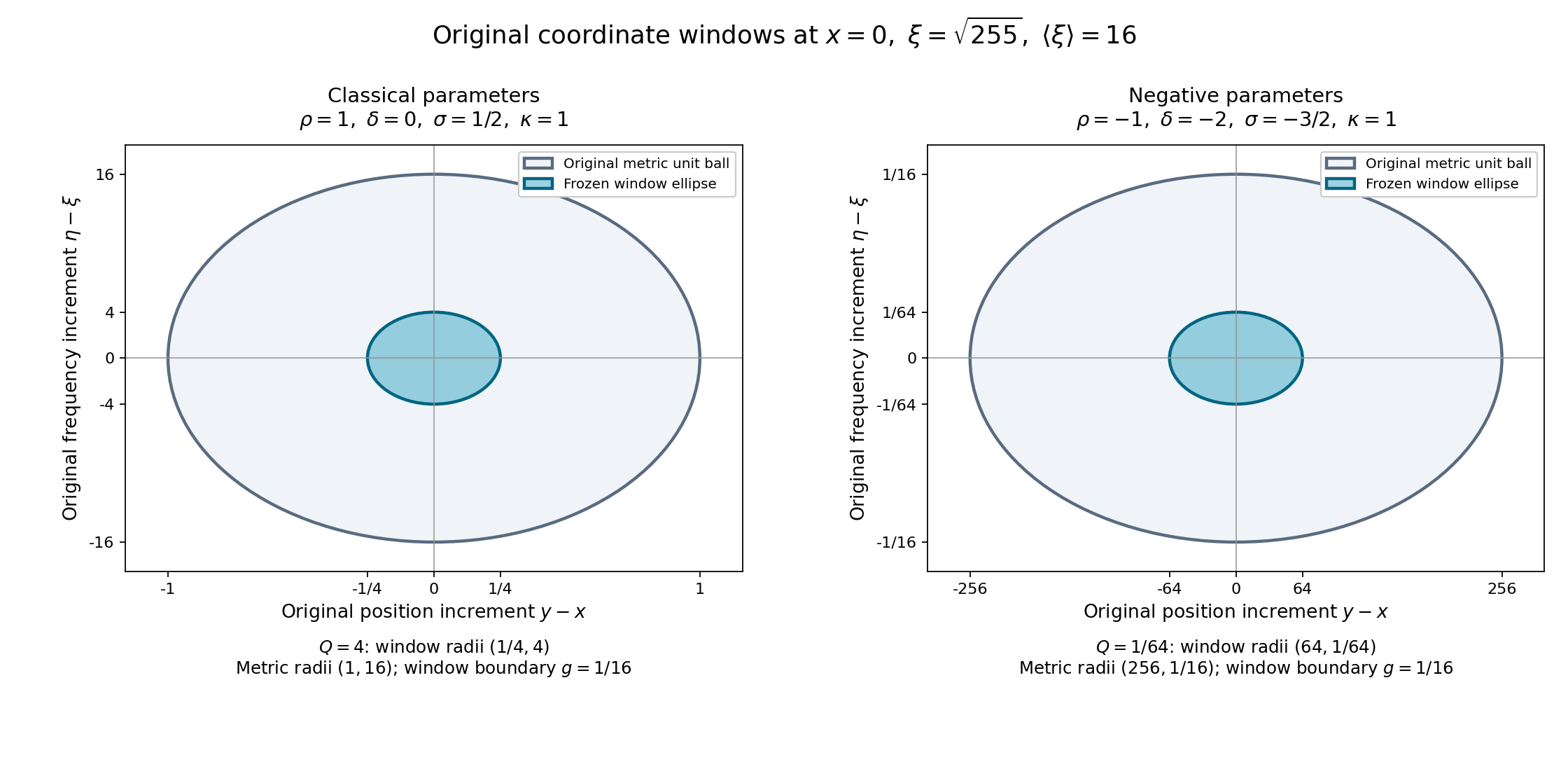
The figure uses , , , hence , for the classical pair and the signed pair . It draws the original tangent coordinates . The inner ellipse is , and the outer one is the original frozen -unit ball. Their radii are respectively , in the first panel and , in the second. Both inner ellipses have area , both outer ellipses have area , and the inner boundary has original metric squared length . These follow directly by inserting each parameter pair in (P8e), (P28e) and (P34); no coordinate rescaling is substituted in the proof. This is a frozen window comparison, not the support of the Schwartz seed or a claim that the moving in (P34) is constant. The complete moving-scale error is proved in (P35)–(P42f).
8. Worked examples
A positive symbol with a negative quadratic form. In one dimension let and . This is a nonnegative classical order-two symbol. For real or complex compactly supported smooth , integration by parts gives Take a nonzero real and . The first term in the last expression is . The second is , which is a negative constant times , up to . To justify that last assertion, subtract the positive mean of the smooth periodic function . Its zero-mean part has a bounded periodic primitive; one integration by parts bounds its integral against by a constant independent of . Thus the quadratic form is negative for all sufficiently large . The positivity of alone did not remove the derivative term in (P56).
An infinite-rank positive coefficient. Let , and let be multiplication by . For a nonnegative scalar , the symbol satisfies (P44), and (P45) applies to -valued Schwartz functions. The coefficient is not a norm limit of finite-rank operators: for every finite-rank , choose a unit vector in its kernel, obtaining . The proof by scalar probes still applies to this coefficient exactly.
Equal derivative costs. Choose a smooth annular cutoff and a scalar , both nonnegative. For , a dyadic sum belongs to : each point meets finitely many frequency annuli, frequency derivatives cost at most , and position derivatives cost . Its boundedness follows from (P14). The moving scale in (P28) is , and the Taylor increment in (P39) is of order one. This example makes visible why no decreasing order was produced at equality, even though an operator bound still holds.
9. Exercises and solutions
1. Why impose evenness on the seed? Suppose an arbitrary Schwartz kernel has total mass one but a nonzero first frequency moment. Determine the leading order of its averaging error for classical symbols at scale .
Solution. At frozen scale use the kernel coordinates , . Before the scale correction, the linear frequency Taylor term is . For its possible size is . The first position moment has the same possible order . These are larger than the desired . Evenness eliminates both fixed first moments. It also eliminates the first correction to the zeroth moment, , which would otherwise again have size . Thus normalization alone is insufficient; two different uses of parity are needed.
2. Choose the window. For a symbol in , suppose a phase-space cell has position radius and frequency radius . Find the value of that maximizes the smaller of the two Taylor gains.
Solution. A position increment has gain ; a frequency increment has gain . Their minimum increases up to their intersection and decreases afterwards. Hence the optimum is , with common gain . Quadratic Taylor terms then have gain . The variation of the chosen window contributes an additional factor , which is no larger than precisely when . This recovers both the balanced scale and the parameter condition used in (P40).
3. Check the distributional transpose on a first-order operator. In one dimension take , where is smooth with bounded derivatives. Compute the bilinear transpose acting on tests, including its zeroth-order term.
Solution. Direct integration by parts in gives . Thus the transpose is , acting from to . In (P11), . The zeroth term is ; the first correction is , and all higher terms vanish. The two calculations agree. This test detects both the reflected frequency and the factor of .
4. Track a shrinking high-frequency support. Let range over a bounded subset of and vanish for . Prove that is uniformly bounded in . Explain why ordinary order-zero boundedness applied to cannot by itself yield an lower error.
Solution. For each , the required weighted norm is . It is zero inside the open ball and bounded by the original order-zero seminorm outside it, because . At the boundary the same estimate holds by smoothness. In contrast, the order-zero seminorms of need not tend to zero: a cutoff that equals one sufficiently far out has supremum one for every . Ordinary boundedness would give only a fixed lower bound by the operator norm. Positivity and the order-one estimate for are what supply (P51).
5. Locate the square-root residual. Explain why the final power in (P48) is , and whether it follows merely from the assertion .
Solution. With the classical balanced window, each scaled increment in a third-order Taylor remainder costs . An order-two input therefore leaves . The degree-zero, degree-one and degree-two terms were retained as actual pointwise derivatives, with coefficients . This is why the residual has that particular power. Membership in alone supplies only and gives no decomposition into those low derivatives and a smaller residual. Higher seminorms of the original symbol control the residual constant.
6. Which part is Hilbertian? Does the proof establish the same and positivity results for all reflexive Banach spaces? Identify exactly which constructions survive without a Hilbert structure.
Solution. Norm-valued Schwartz and symbol estimates, the Bochner integrals, the vector-distribution description (P2)–(P4), the transpose on Banach duals, and the ordered products and all differentiated remainders in (P8)–(P12) survive for reflexive Banach coefficient spaces. Equation (P13) requires the Hilbert adjoint and a Hilbert structure. The moment lemma (P33) is Banach-valued too. The argument uses Hilbert-valued Plancherel and the packet isometry. The positivity statement additionally uses a Hermitian quadratic form and the operator ordering in (P27). Those are extra structures, so the claimed Banach calculus must not be read as a Banach boundedness or positivity theorem. Reflexivity resolves the dual target in (P2); it does not substitute for a Hilbert norm.
Further questions
The moving-window proof here uses the explicit scale in (P28). Lerner’s metric treatment gives Wick positivity and a lower bound for arbitrary Hilbert coefficients in broader metric geometry, while the calculation here identifies the particular moving-window error (P48). Dereziński’s fixed semiclassical scale supplies a related comparison, with different differentiated scale dependence.
Further work can ask which second-order moment tensors are attainable by a normalized positive seed and how constants vary with the window family. The stronger scalar Fefferman–Phong estimate needs a separate argument; it does not follow from the operator-valued estimate (P48). General admissible metrics likewise need their own localization and summation proofs.
References
- Nicolas Lerner, Metrics on the Phase Space and Non-Selfadjoint Operators, chapter 2, §2.4 and Theorem 2.5.4.
- Jan Dereziński, Introduction to Quantization, version dated 19 August 2026, §4.2 and Lemma 10.4–Theorem 10.6.