A full corner recognizes the standard basic construction
A finite matrix model is useful for recognizing a basic construction, but the recognition principle itself has no finiteness assumption. A projection first supplies the expectation by compression. Its symmetry under the standard conjugation then determines the upper algebra. Full central support makes that determination global.
The antecedent is [Takesaki], Chapter XIX, Lemma 3.12. The full-corner argument below replaces its projection-comparison exhaustion with explicit bounded cutoffs.
From one full corner to the whole algebra
For a projection in a von Neumann algebra , its central support is the smallest central projection dominating it.
Lemma 43.1. Let be unital von Neumann algebras on the same Hilbert space. If
then .
Proof. The join of the projections , for , is : that join is fixed by conjugation by every unitary, hence central, and every central projection dominating dominates the join. It is therefore one.
For a finite set and , put
These are positive contractions in . As increases and decreases they increase: inversion reverses the positive order, and
.
For fixed , their limit as is the support projection of . Those support projections have join one. Thus this directed net converges strongly to one.
Writing gives the finite expansion
For , every coefficient is in . Hence
The left side converges strongly to and has norm at most . Strong closure of gives . This proves , and the reverse inclusion was assumed.
Full support is in the smaller algebra . Full support only in does not give this conclusion; Exercise 43.1 shows the difference.
Compression supplies a faithful expectation
Let be unital von Neumann algebras on . Suppose a projection satisfies
Lemma 43.2. There is a unique normal conditional expectation determined by
It is faithful.
Proof. The normal *-homomorphism , , is faithful. Indeed, if , then annihilates every , , since commutes with those unitaries. Their join is , so . Its range is , and its inverse is normal: an increasing bounded positive supremum is characterized by its order, and a *-isomorphism preserves that characterization in both directions.
Compression is normal and completely positive and takes into . Therefore is normal, completely positive and unital. It fixes . Commutation of with gives
, so this is a conditional expectation. Faithfulness of gives uniqueness in (43.6).
To prove faithfulness, set
Every term belongs to , so . The join commutes with , hence belongs to . Since , it commutes with ; thus . Consequently . It dominates , and full central support in (43.5) forces .
If , then , so . The element commutes with every , and therefore annihilates every . Their join is one by (43.7), giving . This is faithfulness.
The standard conjugation fixes the upper algebra
Let be a standard form. In particular . For an expected inclusion , its standard basic-construction algebra is ; a preserving GNS realization identifies it with the algebra generated by and its Jones projection.
Theorem 43.3. For a unital tower on this standard space, the following are equivalent:
has a faithful normal conditional expectation and .
There exists a projection such that
In the second case compression gives the faithful normal expectation of Lemma 43.2, and
Proof of . Lemma 43.2 provides the expectation. Taking commutants in , and using , gives
Conjugate the corner identity by . Since commutes with , we obtain the chain
For the first inclusion, , and commutes with , by conjugating its commutation with . All corners in (43.11) are on ; the chain proves equality.
Apply Lemma 43.1 to , , with the full projection . It gives . Conjugating proves . Equation (43.10) now also gives .
Proof of . Choose a faithful normal semifinite weight on , and put . Faithful normal scalar-weight composition makes faithful, normal and semifinite, with . Work first in its GNS standard form.
The preserving-expectation theorem identifies the projection onto the embedded -GNS space. It gives, for every ,
The representation of on is its faithful GNS representation, so is faithful. If , (43.12) gives , then , and faithfulness of gives . If commutes with , it follows that , so . Thus .
A central projection of annihilating is also in and is zero by faithful compression. Hence . Commutation with and also makes commute with , so .
The commutant calculation, now for , gives
Every word in , compressed by , reduces by (43.12) to an element of . A bounded net from the generated *-algebra approximates any element of strongly. Its compressions have bounded coefficients because is an isometric isomorphism. The normally represented algebra is weakly closed, so .
Finally transport this GNS standard form to the prescribed by the standard-form equivalence theorem, using the identity isomorphism of . The transport intertwines and the represented . It carries to a projection and to . All four conditions (43.8) transport with it. No countable exhaustion or faithful state was used.
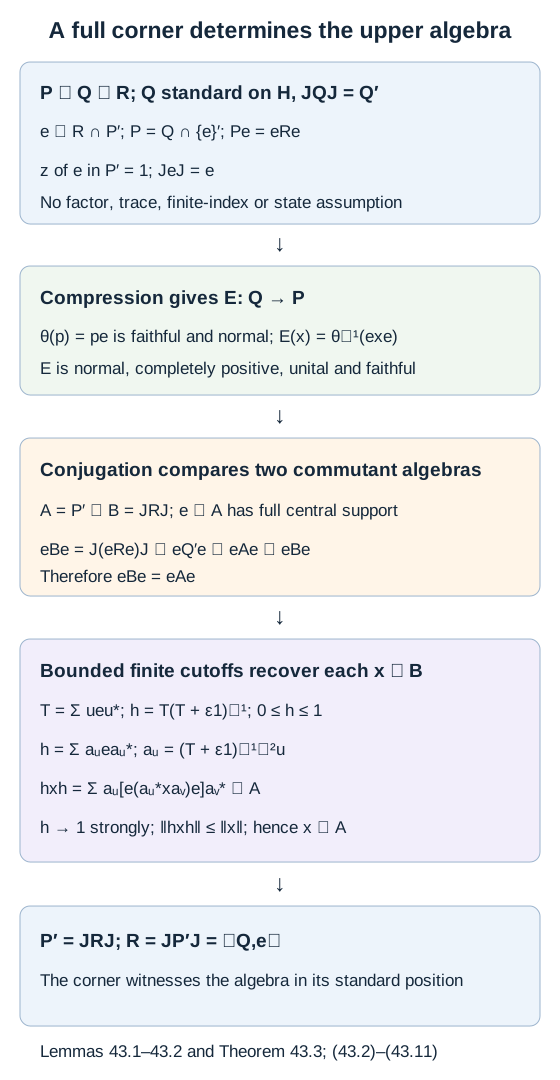
Figure 43.1. Compression determines faithfully. Standard conjugation gives and equality of their -corners. Full support is in ; the finite contractions (43.2) recover every operator from these corners. This proves without a factor assumption or finite index. Editable figure source.
The criterion determines the upper algebra in its prescribed standard position. A witness projection need not be the particular Jones projection for a previously chosen weight. Exercise 43.4 makes that distinction explicit.
Exercises
Exercise 43.1 — introductory. Show why in Lemma 43.1 cannot be replaced by .
Solution. Take diagonal in , and . Then , and , since is a factor. But , and . The unitaries of do not move onto the missing coordinate.
Exercise 43.2 — intermediate. Give a tower satisfying all conditions in (43.8) except full central support, with .
Solution. Represent on its standard Hilbert space , each . Let
and let be the trace-vector projection on and zero on . Then , , and . However , so . The correct upper algebra is
, strictly smaller than . The unobserved second summand can be enlarged without changing the corner.
Exercise 43.3 — advanced. On , take diagonal, , the usual Jones projection , and . Put
Verify every condition in (43.8) except , and show that the standard upper algebra has changed.
Solution. Right multiplication is unitary and commutes with . It preserves , the corner identity and full central support in under conjugation. In the ordered matrix-vector basis ,
The conjugation interchanges the second and third real basis vectors, so . Right multiplication by , with matrix , belongs to , but does not commute with . Therefore , while , proving . The conjugation condition fixes the standard position that right-unitary conjugation changed.
Exercise 43.4 — advanced. For on the tracial standard space, let , and let project onto the line spanned by . Verify (43.8) for . Compare with the trace-vector Jones projection.
Solution. The vector has norm one, is fixed by , and has invertible matrix representative. A matrix commuting with its line projection must satisfy , hence is scalar. Thus . Its corner is . The algebra is a factor, so has full central support. All conditions hold and the theorem correctly gives .
Compression gives
, so the expectation is the trace. Yet , because . Thus this witness differs from the Jones projection onto for the prescribed tracial realization. Recognition of the algebra does not assert equality of these two projections.