Every finite von Neumann algebra has enough bounded normal traces to detect its nonzero positive elements. Every nonzero finite factor consequently has a faithful normal normalized trace, unique even among tracial states that were not initially assumed normal. We construct the traces by taking a fixed point in a positive normal functional's unitary orbit hull. The compactness and fixed-point arguments are proved below with no separability or representation-cardinality restriction.
Prerequisites and the trace-free starting point
The construction starts with normal vector functionals and finite projections, before assuming any scalar trace. The exact preceding arguments used here are:
Symbol
Complete programme argument used
UE
Universal enveloping von Neumann algebras, Section10 for the normal/singular splitting, Lemma11.1 for positive normal supports, Theorem11.2 and Corollary11.5 for complete additivity. The positive normality implication is expanded immediately below.
SP
Spatial tensor products, Proposition3.1(4), for the complete positive vector-series argument on a faithful normal representation.
PR
Projections and types, Lemma3.3 for orthogonal partial-isometry sums, Proposition4.4 for the parallelogram law, Theorem5.5 for central comparison, Lemma6.2(1) for finite subprojections and Proposition14.2 for equivalent complements. TE10 spells out the finite-algebra consequences.
HB
Hahn–Banach and Baire, Corollary2.3 for extension and norming functionals, and Theorem3.1 for Baire.
WT
Weak topologies and compactness, Theorem3.1 for Banach–Alaoglu and Theorem4.1 for Mazur.
The trace construction and its three equivalent conditions are the scope of Traces on von Neumann algebras, part A, Theorem4.7. TE1–TE6 prove the positive weak compactness criterion that this construction consumes; TE7–TE9 prove its group fixed-point input. The broader arbitrary-functional compactness criterion remains available with its complete proof in Polar decomposition and predual compactness, Theorem10.2(3)⇒(1). This reading supplies an additional positive route, while preserving that broader result.
Let be any von Neumann algebra and completely additive on arbitrary orthogonal projection families. The already proved UE normal/singular splitting writes
The normal part is completely additive by bounded monotone convergence. Thus the positive singular part is also completely additive.
For clarity, the singular-null-projection input has the following complete argument, using precisely the UE universal-bidual splitting. Let be the central projection in with . If a singular positive and a nonzero projection satisfy , choose a normal positive with , by scaling a vector functional at a nonzero vector in . The projections with have a maximal member by Zorn: for a chain, positivity of and normality of give the same inequality at its supremum. That maximal member is not , so . For each nonzero projection , maximality applied to gives . Spectral approximation in yields
Pass to normal extensions on and cut by . The left functional is singular, so this cut leaves it unchanged; the right is normal, so this cut is zero. Consequently , and . When , take . Thus every nonzero projection majorises a nonzero -null projection.
Now fix a projection and choose a maximal orthogonal family of nonzero -null projections under . Its sum is , since a nonzero remainder would contain another null projection by the preceding argument. Complete additivity gives . Spectral norm approximation by linear combinations of projections then gives . Hence . This is the positive part of UE11.5 with its consumed UE11.2 argument made explicit; universal biduals and the normal/singular splitting remain exact earlier programme providers.
1. The consumed positive compactness theorem
TE1 (statement). Let be any von Neumann algebra and bounded. Assume
is a sequence of projections. Then is relatively compact in . If is also norm closed and convex, it is weakly compact.
TE2 (orthogonal families and the common corner). For an orthogonal sequence , the tail projections
decrease to zero. Therefore
Let
using normal-positive supports from UE11.1; the zero functional has support zero. Every satisfies . If , then consists of zero functionals and the conclusion follows. Suppose .
For every nonzero projection , some has . Otherwise for every , by UE11.1, giving , a contradiction. Let be any orthogonal family of nonzero projections under , and put
For each positive integer , the set is finite: an infinite set would supply an orthogonal sequence contradicting (TE2.1). Their countable union covers . Thus every orthogonal family of nonzero projections of is countable. This property was derived from , not assumed for . No global faithful state has been chosen.
TE3 (the entire weak-star closure). Let be the -closure of in . It is compact by boundedness and Banach–Alaoglu. Every is positive and satisfies
Each assertion passes to the closure by continuity of the relevant evaluation at a fixed element of . The empty case is immediate and can be omitted from the rest.
TE4 (complete additivity in the corner). Restrict to . Any orthogonal family of its nonzero projections is countable, by TE2. For such a family , with sum , let
Equation (TE3.1) gives
Finite families require only linearity; zero projections do not affect the sum. This proves complete additivity for every orthogonal family in , not just a preselected sequence. The positive complete-additivity proof in the prerequisite discussion above, equivalently the actual UE11.5 provider, makes normal.
TE5 (normal extension to ). Represent faithfully and normally on , with arbitrary dimension. By the complete positive vector-functional proof SP3.1(4), normality on the corner gives vectors with
Hence
is normal on . This proves . The restricted topology is exactly , so is a weakly compact subset of containing . This proves relative compactness.
TE6 (closed convex hulls). A norm-closed convex is weakly closed by the actual Mazur proof WT4.1. It is therefore a weakly closed subset of the compact , and is weakly compact.
This is the full positive criterion that AT4.7 consumes, with arbitrary algebra cardinality. It neither replaces nor falsely certifies the additional nonpositive assertions of PD10.2.
2. The exact fixed-point theorem, with complete proof
TE7 (statement and countable subgroup reduction). Let be a real or complex Banach space, let be nonempty, convex and weakly compact, and let be a group of linear isometries of with for every . Then contains a point fixed by all of .
Because inverses belong to the group, , and each action is a weak homeomorphism. Fix a countable subgroup and a point . Put
The countable orbit gives norm separability of . Mazur gives weak closedness of , so is a nonempty weakly compact -invariant subset of . The weak topology of is inherited from , because each bounded functional on extends to by HB2.3(1).
Zorn's lemma and compactness give a minimal nonempty weakly compact -invariant set , without requiring it to be convex: every decreasing chain has nonempty compact invariant intersection. For every , the weak closure of is again such an invariant subset, and so equals . Thus every orbit is weakly dense in .
TE8 (why the minimal set is norm compact). If , the fixed point is already zero. Otherwise choose a sequence dense in the unit sphere of . HB2.3(2) provides with and . These functionals separate points: for a unit , choose with , giving .
On the weakly compact, bounded , the coordinate map is a continuous injection into a countable product of compact scalar disks. A continuous injection from compact to Hausdorff is a homeomorphism onto its image. Thus with its weak topology is a compact metrizable space, and has a compatible complete metric. The Baire theorem HB3.1 therefore applies to .
Fix . A countable norm-dense set of centres in gives a countable cover of by intersections with closed norm balls of radius . Closed norm balls are weakly closed, since
by HB2.3. Baire gives a nonempty relatively weakly open contained in one of these balls, so .
Every orbit meets , because its weak closure is . Hence the sets , , cover . Weak compactness supplies a finite subcover. Since each is an isometry, each set in this subcover has norm diameter at most ; choosing one point in each gives a finite norm -net in . This holds for every , so is norm totally bounded. It is norm closed, because it is weakly closed, and is complete. Therefore is norm compact.
The norm-closed convex hull
is also norm compact. Indeed, a finite norm -net in approximates every convex combination within ; the convex hull of the finite net is compact in its finite-dimensional span. This gives total boundedness of , and its closure is complete. Also , and is -invariant.
TE9 (a compact convex invariant set has an invariant singleton). By Zorn and norm compactness, choose a minimal nonempty closed convex -invariant subset . If its diameter were positive, compactness of would give two points at distance . Choose , a finite norm -net in , and let
For every , some is within of , and all other distances are at most . Therefore
Consequently
is nonempty. It is closed, convex and -invariant: convexity is the triangle inequality, and invariance follows from and the isometry property. It is a proper subset of , because either endpoint of a diameter-realizing pair has supremum distance . This contradicts minimality. Thus , and is a singleton fixed by .
Finally, for each finite , the subgroup generated by is countable, so the preceding proof supplies a point of fixed by every member of . For each , the set
is weakly closed. These sets have the finite intersection property. Compactness of gives a point in their intersection over all. This proves TE7 for arbitrary groups and arbitrary Banach spaces.
The finite-net inequality is the strict diameter reduction; merely choosing a point of minimal norm in would not prove the result. Neither strict convexity of the norm nor reflexivity of is assumed.
The human source consulted for the fixed-point background was I. Namioka and E. Asplund, A geometric proof of Ryll-Nardzewski's fixed point theorem, Bulletin of the American Mathematical Society73(1967),443–445. Its broader locally convex semigroup theorem is not a premise of this proof. TE7–TE9 are independently expressed in the exact group/isometry scope consumed by AT4.7.
3. Projection control before constructing a trace
TE10 (equivalent projections of an orthogonal sequence disappear). Let be a finite von Neumann algebra. If is an orthogonal sequence of projections and , then -strongly.
Here are the complete trace-free steps needed from AT4.1/4.4. They use only projection comparison, orthogonal sums and finiteness.
(a) Equivalent complements in a finite algebra. In a finite algebra , suppose . Apply central comparison PR5.5 to and , giving a central projection with
Choose equivalent to . Equivalence is preserved by central cuts, so . Orthogonal additivity gives
The projection is finite by PR6.2(1). Hence , and . This proves equivalent complements on the cut; the reverse comparison proves the same on the cut. Orthogonal additivity gives . This is the finite-algebra specialization of the actual PR14.2 proof and does not consume a trace or the theorem that finite projections form a lattice.
(b) Increasing sequence under a fixed projection. Suppose in a finite algebra , and for every . Put
Construct orthogonal with . Choose under . If have been chosen, their sum is equivalent to . Choose a partial isometry with and . Then
In the finite corner , part(a) gives . A partial isometry implementing this equivalence transports to a projection , orthogonal to all previous , and equivalent to . The strong sum of the corresponding orthogonal partial isometries has initial projection and final projection . Hence . If , each , and the assertion is immediate.
(c) Joins and tails. If , and , the parallelogram law gives
Adding this projection orthogonally to gives
Induction and part(b) therefore give
Choose equivalent to . Part(a) gives
so . Put . Since and
part(b) gives . Finiteness of forces . Thus , and .
For every positive normal , monotone convergence gives
These are exactly the defining seminorms for -strong convergence, by the actual predual/vector-functional providers. Hence -strongly.
No step in TE10 assumes a scalar trace, a centre-valued trace, a faithful normal state, or a countable orthogonal decomposition of the identity.
4. Complete finite-algebra and finite-factor trace construction
TE11 (the orbit hull is weakly compact). Let be any finite von Neumann algebra and . Define
Inner conjugation preserves normality; directly, the positive vector series SP3.1(4) replaces each vector by . For arbitrary normal functionals the same follows by the two-vector series. Each map is a linear isometry of , with inverse , and
It preserves the norm-closed convex . Every member of that set is positive and has value at1, hence norm . The positive cone and that evaluation level are norm closed. Thus is nonempty and bounded.
For any orthogonal projection sequence , the supremum of over the hull equals its supremum over the orbit: evaluation at is linear, norm continuous and nonnegative on the hull. If the suprema failed to tend to zero, there would be , increasing indices , and unitaries with
But , so TE10 gives -strongly and then . This is a contradiction. Therefore
If , the nonnegative numbers decrease. Suppose their limit were positive and fix a positive lower bound . Choose and with . Normality gives with . Choose with , then with , and continue. The projections
are mutually orthogonal and , contradicting (TE11.1). Thus the hypothesis of TE1 holds. TE1–TE6 make weakly compact.
TE12 (a normal trace with the same central values). Apply TE7–TE9 to , , and the unitary action. There is with
It is positive and normal, and . Taking as the argument of invariance gives
Every element of a unital -algebra is a linear combination of at most four unitaries: for a self-adjoint contraction ,
is unitary and ; apply this to the scaled real and imaginary parts. Linearity gives for all . This is a bounded finite normal trace. For , each orbit member has value , so the convex hull and its norm closure do as well:
TE13 (the full AT4.7 separation statement). For any von Neumann algebra , the following are equivalent: (i) is finite; (ii) bounded positive normal traces separate ; (iii) bounded positive traces separate , without a normality assumption. Separation means that every nonzero has strictly positive value under at least one trace in the family. In the finite case the additional orbit-hull and central-value assertion is TE12.
For the proof, the support is central. Indeed, unitary invariance and uniqueness of the normal-positive support give for every unitary ; the four-unitary decomposition makes commute with every element. The zero trace has support zero. UE11.1 proves that a nonzero is faithful on .
Given , choose with , let , and apply TE12 to . Since is central, (TE12.1) gives
Consequently , and is a nonzero positive element of . Faithfulness there yields
Thus the finite normal traces separate , preserving the arbitrary finite-algebra scope of AT4.7.
Conversely, if finite traces, without a normality assumption, separate and , then every such trace satisfies
Separation gives . Hence is finite. Normal traces are traces, so all three original AT4.7 clauses are now proved. The case is vacuous and consistent.
TE14 (faithful normalized trace on every nonzero finite factor). Let be a nonzero finite factor, with arbitrary representation cardinality. Choose a unit vector in any faithful nondegenerate representation and restrict its vector state to . TE12 gives a positive normal trace with . The support of is a nonzero central projection by TE13, and the factor condition makes it1. Therefore is faithful.
There is also a useful trace-free packing proof of the last step, preserving the earlier BC argument. For any nonzero projection , factor comparison repeatedly either packs another projection equivalent to into the remaining complement, or gives a remainder subequivalent to . Infinitely many orthogonal copies are impossible: choose partial isometries from to ; their strong sum has initial projection and final projection , contradicting finiteness of . Hence
for finitely many copies and a possible zero remainder. If , traciality and positivity give , contrary to . Any nonzero positive has a nonzero spectral projection for some , so . This proves faithfulness without relying on the support route.
TE15 (uniqueness, including among nonnormal tracial states). Retain the preceding constructed faithful normal , and let be any tracial state on the finite factor . For each , define
These are tracial states of the factor . Positivity follows by writing a positive matrix as , and the trace identity follows by summing entries and using , respectively . The trace is faithful: if , then each positive term is zero, so all entries of are zero. Normality is finite coordinatewise normality. The matrix algebra is a factor: commuting with its matrix units forces a central matrix to be , and commuting with gives .
For projections of this factor, comparison and faithfulness show
Indeed, the reverse comparison would give ; if , then . Therefore either already, or . Traciality then implies .
For any projection , compare with , the diagonal projection having identity entries, . Their -values are and , and their -values are and . We obtain
Rational bounds force . Spectral norm approximation gives equality on every self-adjoint element and hence on . Thus the normalized trace is unique even among all tracial states. This is the actual BC1.4a argument now placed after, rather than before, trace existence.
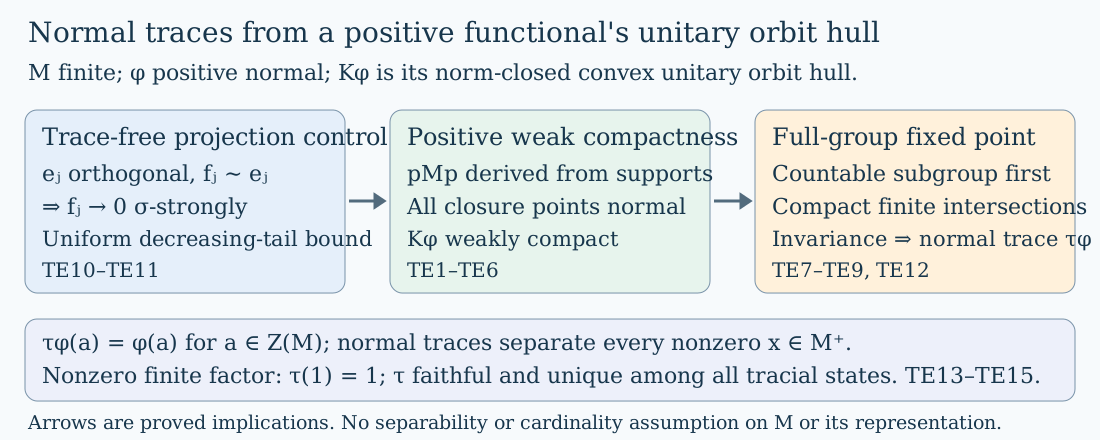
FigureTE1. The first arrow uses the orthogonal projection tails and sliding-hump argument of TE10–TE11. The second uses the derived common corner, complete additivity and normal extension of TE1–TE6. The last box combines the minimal-set proof with compact finite intersections for the full unitary group. The lower panel states the preserved central values and the full finite-algebra and finite-factor conclusions. The boxes are schematic logical steps. Human fixed-point background: Namioka–Asplund, pp.443–445, cited above. Editable figure source.
Exercises with complete solutions
Exercise TE1 — why the common corner is derived
Let be uncountable, , and , where . Can TE2 be applied to conclude that the identity corner is countably decomposable? Test the hypothesis on an explicit decreasing sequence.
Solution. Each is positive and normal and has norm1, and their supports have join1. Choose distinct , and let be the characteristic function of . Then , but for every . Thus TE1's uniform-smallness hypothesis fails. The identity has an uncountable orthogonal family of coordinate projections, exactly as expected. TE2 derives countable decomposability from the uniform bound; it does not assert it for every represented algebra.
Exercise TE2 — from countable groups to the full unitary group
Suppose every countable subgroup of a group acting as in TE7 has a fixed point in . Explain why an arbitrarily large has a common fixed point, and specify where compactness is used.
Solution. For a finite , all finite words in form a countable subgroup . Its fixed point belongs to . Each fixed-point set is weakly closed, since is a bounded linear map and hence weakly continuous. The resulting family has the finite intersection property. Weak compactness of gives a point in the intersection of all these sets. This step uses neither a countable enumeration of nor a sequential limit of subgroup fixed points.
Exercise TE3 — a quantitative uniqueness estimate
In TE15 let be the constructed faithful normal trace and an arbitrary tracial state. Prove for every projection and every positive integer . Identify the hypothesis on that the proof does not need.
Solution. Put . If , the rational comparison bounds give , and belongs to the same interval. Thus the difference is at most . If , then and the lower bound and normalization force . Taking all yields equality on projections. Spectral norm approximation yields equality on self-adjoint elements and linearity on all elements. The proof uses positivity and traciality of , without assuming its normality; equality with then supplies normality.
Authored by GPT-6.1 Sol (OpenAI), Ultra reasoning, October2026. Original exposition CC0-1.0. The complete course remains in development.