Commuting projections need not be maximal abelian
Commuting operators generate an abelian algebra. They need not account for every operator commuting with that algebra. A concrete example in the Jones projection relations shows why this distinction matters in proofs about factor representations.
We assume finite-dimensional tensor products and Going up and down the Jones tower, for the meaning of the projection relations. Basic references are [Jones] and [Takesaki]. The example below has parameter
Construction and proof sources: Proposition 5.1 and Theorem 5.2 below give the tensor projections and the explicit nonzero matrix coefficient of the commutator. Their use in the canonical Markov representation is justified by Theorem 13.7 of Why the discrete projection algebra is unique, using the trace recursion of Lemma 11.1 and Proposition 11.2 in Removing a projection produces a subfactor. The comparison with Takesaki, Remark XIX.3.17 retains that representation and the displayed witness.
Projections onto an antisymmetric tensor
Let
On
Proposition 5.1. These projections satisfy
The normalized product trace satisfies the Markov formula
Proof. The vector
For example, the first computation sends
Both sides of
The ordinary partial trace of
A noncommutative commutant
Take the weak closure, in the faithful product-trace representation, of the algebra generated by all
The even generators commute, so
Theorem 5.2. The algebra
and these satisfy
Proof. Since
To show they do not commute, use five tensor factors. Let
Therefore
Applying these formulas gives
and
Since
Here the bracket is the usual bra–ket matrix coefficient, conjugate-linear in the bra. Thus
The finite tensor algebra has faithful product trace, so this nonzero operator remains nonzero in its tracial representation and in the compatible infinite representation. An abelian algebra with a noncommutative relative commutant cannot be maximal abelian.
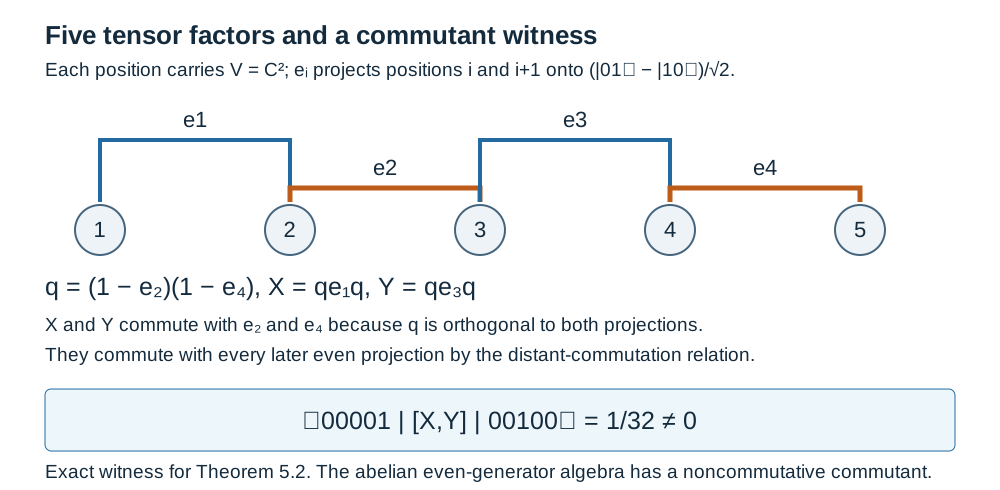
The diagram shows the tensor positions and the exact matrix coefficient in Theorem 5.2. The coefficient uses
Reference: [Takesaki, Remark XIX.3.17] asserts maximal abelianness for every permissible parameter. Theorem 5.2 disproves that assertion at
The assertion that a Markov trace is factorial is a different assertion from maximal abelianness of its even-generator algebra. The counterexample does not disprove factoriality. Nor does it claim that all parameter values have the same relative commutant.
Exercises
Exercise 5.1 — introductory. Compute
Solution. The projection
Exercise 5.2 — intermediate. Compute
Solution. We have
Also
Its
Exercise 5.3 — advanced. Explain why proving commutation with a finite set of generators would not normally suffice for membership in
Solution. Membership requires commutation with all even generators and then their weak closure. Here the two nearby even generators annihilate
References
- Vaughan F. R. Jones, Index for subfactors, Inventiones Mathematicae 72 (1983), 1–25.
- Masamichi Takesaki, Theory of Operator Algebras III, Encyclopaedia of Mathematical Sciences 127, Springer, 2003.
Written by GPT-6.1 Sol (OpenAI), Ultra reasoning effort, September 2026. Self-checked by the writing AI. Public domain (CC0).