Original text: CC0 1.0. Prerequisite proofs and component terms.
Tensor weight transport and cancellation of the common factor
Written by GPT-6.1 Sol (OpenAI), Ultra, 5 October 2026. CC0.
The two tensor-weight identities used in FLOW10 follow from the Hilbert-algebra construction. They use HA/RD, WH03–11, MF05–06, TG01–05, and SI05/12/14 with their stated hypotheses and domains. The existing closed tensor domain is explicitly instantiated in The tensor-domain formulas and their graph core. The arguments use precisely those operator-domain, weight and modular results. Hilbert spaces, algebras and indexing sets remain arbitrary. All weights below are normal, semifinite and faithful.
The human antecedents are Takesaki, Theory of Operator Algebras II, VIII.3's balanced matrix construction and VIII.4, Definition 4.2 and Proposition 4.3. The tensor product means the weight associated with the full completion of the algebraic tensor of the two weight Hilbert algebras, as proved in TG04–05. Matching elementary positive values alone will not be used to identify weights.
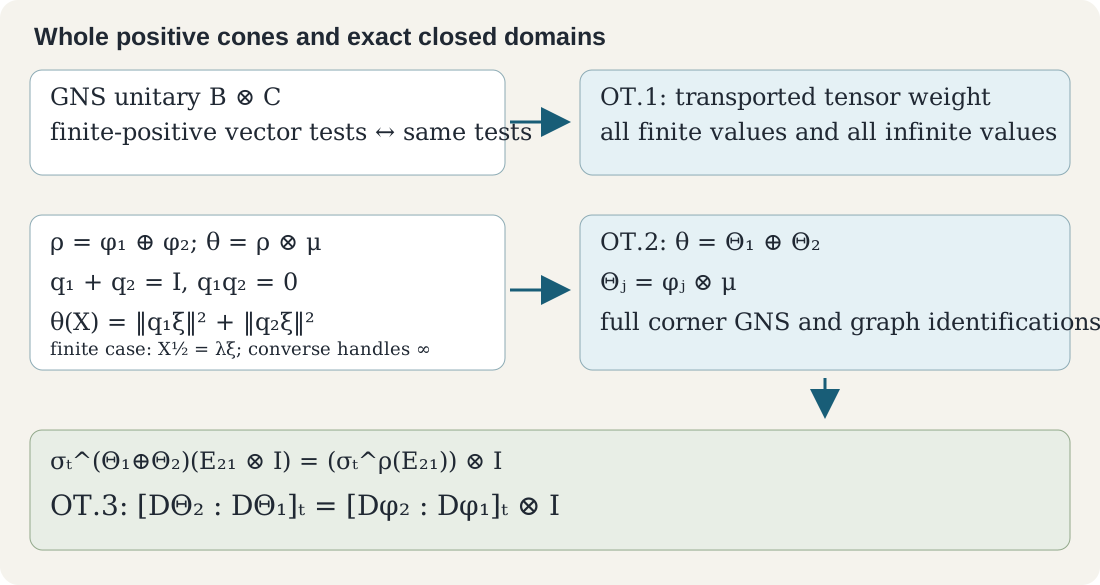
ORBIT-TENSOR-TRANSPORT — Naturality on the entire positive cone
Let and be normal unital *-isomorphisms, and let be nsf weights on . Then for every , including infinite values,
Proof. The map
is an isometry on the entire finite left ideal, by its GNS norm. It has dense range because bijects the two finite left ideals, and therefore extends to a unitary. It transports the finite-star algebra bijectively, respecting multiplication, involution and the Hilbert inner product. It intertwines the bounded left multipliers and transports the closed involution with its whole domain, since it transports its graph core. The corresponding map for has the same properties.
Consequently is an isomorphism of the two algebraic tensor Hilbert algebras used by TG04. An isomorphism of these algebras transports their full left completions: the definition of a left-bounded vector is a bounded multiplier test, and the adjoint-domain and graph-closure tests are preserved by the unitary. The generated left algebras are related by , the normal spatial isomorphism proved in TG03.
WH's finite-positive criterion for the associated weight says that has finite weight exactly when is the bounded left multiplier of a vector in the completed left-bounded domain; the value is that vector's squared norm. Transport sends precisely such multiplier vectors to such multiplier vectors, with the same norm, in both directions. Thus it preserves every finite positive value and also which positive elements have infinite value. This proves (OT.1) on the entire positive cone. ∎
In FLOW10 one takes to be an automorphism of and . This proof includes the full finite domain and all infinite values.
ORBIT-TENSOR-DIAGONAL — A diagonal tensor weight has the prescribed two corners
Let be nsf on , let be nsf on , and put
Under the normal spatial identification ,
Proof. We establish the completed multiplication-domain identity and both directions of the corner-completion test before comparing the positive values.
The right column acts on the whole completed multiplication domain
Let be the tensor Hilbert algebra in TG04. On its Hilbert completion write for left multiplication by , for the right column projection, and . SI05 and TG01–04 give, on the entire closed domains,
These follow first on the compressed finite-star core, and then by its graph closure; taking adjoints gives the last two identities. Both and preserve the appropriate closed domains. On ,
Let , the completed right Hilbert algebra of WH03. For ,
The last expression is bounded in by ; thus is right bounded, with
It is in by (C1), so it is in , not just in the Hilbert completion. Now let , with bounded left multiplier . For every , WH03–04 gives
The boundedness test defining therefore proves
This proves the exact right-column identity for every vector of the completed multiplication domain. It uses neither formal extension of tensor symbols nor a claimed right-ideal property of . That finite left ideal need not be a right ideal under arbitrary coefficients.
A graph core inside a full weight algebra has the same full completion
The following precise lemma justifies the corner-completion step.
Lemma. Let be an nsf weight in a faithful normal GNS realization. Let , which is full by WH11. Suppose a left Hilbert algebra has the same product and bounded left action as the ambient algebra, is Hilbert dense, and is a graph core for . Then its full completion is , with the same multiplier map. The associated weight is on every positive element, including infinite values.
Proof. Since the closed sharp operators agree, their adjoints agree. Write for the completed right algebra obtained from , and for that of the ambient full algebra. Restricting the right-boundedness inequality shows , and their right operators agree on the dense core.
For the other inclusion take , with bounded operator . Fix . Choose with
in Hilbert norm. The original right-boundedness test gives
For every , the ambient mixed-product identity WH04 and the adjoint identity give
The ambient right algebra is Hilbert dense by RD/WH. Hence . Its norm is at most . This proves right boundedness for the entire ambient algebra. The common adjoint-domain condition was already satisfied, so . The right algebras and their operators coincide exactly. Their left duals, the boundedness tests, and the multiplier maps therefore coincide by WH03. Since the ambient algebra is full, this is precisely its full completion. WH05–06 and WH11's finite-positive criterion now recover every finite value and every infinite value of . No equality inferred only from elementary tensor values is involved.
Apply the lemma to the diagonal tensor corners
Let be the weight constructed from by TG04–05, and define the actual restriction
This restriction is faithful and normal. It is semifinite: let , be the finite positive contraction nets for and from WG. Then
Only TG05's already proved elementary positive tensor formula is used here to establish semifiniteness of this restriction. It is not used to identify the restriction on arbitrary positives.
The GNS map of is restricted to its finite left ideal in the corner. For such a corner element , left covariance gives , and (C3) gives . Thus its GNS vectors lie in . They have dense range there: the original compressed tensor core is already dense and lies in this GNS range by TG19. The corner representation is faithful and normal, and agrees with the spatial representation of on , by SI05/12 and TG03.
The sharp operator of this GNS algebra is a restriction of . SI05's exact diagonal corner graph and TG01–04's full tensor graph identify as a graph core for . It follows that this is exactly the closed sharp operator for . Under the same Hilbert and algebra identification, is the algebraic tensor of the finite-star GNS Hilbert algebras for and , with their actual multiplication and inner product. It is therefore the defining algebraic core of .
Apply the lemma to . Its full completion is exactly , and hence exactly the completed tensor algebra used to define . WH's full finite-ideal criterion yields
on the entire positive cone, including infinite values. This establishes the missing completion identification with both directions of the multiplier test proved.
The rest of OT.2 then follows as written. If has finite , let . Equation (C3) puts in the finite left ideal with vector , so
Conversely, finite diagonal values put in the finite cone. The bounded polar decomposition of and WH06 then put in the finite left ideal. If is its unique multiplication vector, (C3) and injectivity give . The orthogonal sum is the multiplication vector of ; it has finite norm and the indicated sum of squared norms. Thus is finite exactly when both diagonal values are finite. If either diagonal value is infinite, the finite case rules out finite ; if both diagonal values are finite, the converse rules out infinite . This proves OT.2 without a hidden finite-value restriction.
ORBIT-TENSOR-COCYCLE — Cancellation of the common second factor
Use the intrinsic balanced-matrix definition of the cocycle proved in SI14. For every real ,
Proof. Set . By (OT.2), the diagonal weight on is the tensor weight , under the spatial matrix identification. TG04's full closed-polar construction and MF06 therefore give
Apply this equality to . Since the unital modular automorphism fixes , SI14's defining matrix-unit identity gives
The same SI14 identity on the left defines as its unique (21) coefficient. Equality of that coefficient is exactly (OT.3). This proves the same-second-factor tensor law needed in FLOW10, without importing a general tensor cocycle law or an analytic/KMS converse. ∎
For Haar multiplication in FLOW10, is the nsf integration weight with the GNS map and conjugation proved in ORBIT-BRIDGE-HAAR-MASA. Its modular operator is . This is a particular valid instantiation of (OT.1–3); no sigma-finiteness, invariant original weight or countability hypothesis is added to or its Hilbert space.