Reading guide · Proof index

The Riemann integral

Jiří Lebl, Basic Analysis I–II, version 6.3. Free author edition of this section. Selection and attribution · Notation.

L5.1.2: Darboux sum bounds and existence of their defining finite extrema.

Proof.

Let PP be a partition of [a,b].[a,b]\text{.} Note that for all i,i\text{,} we have m≤mi≤Mi≤M.m \leq m_i \leq M_i \leq M\text{.} We also have ∑i=1nΔxi=(b−a).\sum_{i=1}^n \Delta x_i = (b-a)\text{.} Therefore,
m(b−a)=m(∑i=1nΔxi)=∑i=1nmΔxi≤∑i=1nmiΔxi≤∑i=1nMiΔxi≤∑i=1nMΔxi=M(∑i=1nΔxi)=M(b−a).\begin{gathered} m(b-a) = m \left( \sum_{i=1}^n \Delta x_i \right) = \sum_{i=1}^n m \Delta x_i \leq \sum_{i=1}^n m_i \Delta x_i \\ \leq \sum_{i=1}^n M_i \Delta x_i \leq \sum_{i=1}^n M \Delta x_i = M \left( \sum_{i=1}^n \Delta x_i \right) = M(b-a) . \end{gathered}
Hence, we get (5.1). In particular, the sets of lower and upper sums are bounded sets.

L5.1.7: Both refinement inequalities; omitted upper half supplied by P12.2.

Proof.

The tricky part of this proof is to get the notation correct. Let P~={x~0,x~1,…,x~ℓ}\widetilde{P} = \{ \widetilde{x}_0, \widetilde{x}_1, \ldots, \widetilde{x}_{\ell} \} be a refinement of P={x0,x1,…,xn}.P = \{ x_0, x_1, \ldots, x_n \}\text{.} Then x0=x~0x_0 = \widetilde{x}_0 and xn=x~ℓ.x_n = \widetilde{x}_{\ell}\text{.} In fact, there are integers k0<k1<⋯<knk_0 < k_1 < \cdots < k_n such that xi=x~kix_i = \widetilde{x}_{k_i} for i=0,1,2,…,n.i=0,1,2,\ldots,n\text{.}
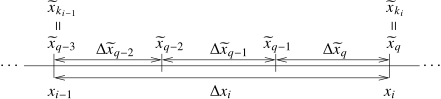
Let Δx~q≔x~q−x~q−1\Delta \widetilde{x}_q \coloneqq \widetilde{x}_q - \widetilde{x}_{q-1} for q=0,1,2,…,ℓ.q=0,1,2,\ldots,\ell\text{.} See Figure 5.2. We get
Δxi=xi−xi−1=x~ki−x~ki−1=∑q=ki−1+1kix~q−x~q−1=∑q=ki−1+1kiΔx~q.\begin{equation*} \Delta x_i = x_i - x_{i-1} = \widetilde{x}_{k_i} - \widetilde{x}_{k_{i-1}} = \sum_{q=k_{i-1}+1}^{k_i} \widetilde{x}_{q} - \widetilde{x}_{q-1} = \sum_{q=k_{i-1}+1}^{k_i} \Delta \widetilde{x}_q . \end{equation*}

A diagram of an interval between x sub quantity i minus 1 and x sub i of width Delta x sub i. It is divided into three smaller intervals. The left hand endpoint x sub quantity i minus 1 is also marked as tilde x sub quantity q minus 3 and tilde x sub quantity k sub quantity i minus 1. Similarly the right hand endpoint x sub i is also marked as tilde x sub q and tilde x sub k sub i. The two inside points are marked as tilde x sub quantity q minus 2 and tilde x sub quantity q minus 1. The three intervals are of length Delta tilde x sub quantity q minus 2, Delta tilde x sub quantity q minus 1, and Delta tilde x sub q.
Figure 5.2. Refinement of a subinterval. Notice Δxi=Δx~q−2+Δx~q−1+Δx~q,\Delta x_i = \Delta \widetilde{x}_{q-2} + \Delta \widetilde{x}_{q-1} + \Delta \widetilde{x}_{q}\text{,} and also ki−1+1=q−2k_{i-1}+1 = q-2 and ki=q.k_{i} = q\text{.}

Let mim_i be as before and correspond to the partition P.P\text{.} Let m~q≔inf⁡{f(x):x~q−1≤x≤x~q}.\widetilde{m}_q \coloneqq \inf \bigl\{ f(x) : \widetilde{x}_{q-1} \leq x \leq \widetilde{x}_q \bigr\}\text{.} Now, mi≤m~qm_i \leq \widetilde{m}_q for ki−1<q≤ki.k_{i-1} < q \leq k_i\text{.} Therefore,
miΔxi=mi∑q=ki−1+1kiΔx~q=∑q=ki−1+1kimiΔx~q≤∑q=ki−1+1kim~qΔx~q.\begin{equation*} m_i \Delta x_i = m_i \sum_{q=k_{i-1}+1}^{k_i} \Delta \widetilde{x}_q = \sum_{q=k_{i-1}+1}^{k_i} m_i \Delta \widetilde{x}_q \leq \sum_{q=k_{i-1}+1}^{k_i} \widetilde{m}_q \Delta \widetilde{x}_q . \end{equation*}
So
L(P,f)=∑i=1nmiΔxi≤∑i=1n ∑q=ki−1+1kim~qΔx~q=∑q=1ℓm~qΔx~q=L(P~,f).\begin{equation*} L(P,f) = \sum_{i=1}^n m_i \Delta x_i \leq \sum_{i=1}^n \, \sum_{q=k_{i-1}+1}^{k_i} \widetilde{m}_q \Delta \widetilde{x}_q = \sum_{q=1}^{\ell} \widetilde{m}_q \Delta \widetilde{x}_q = L(\widetilde{P},f). \end{equation*}
The proof of U(P~,f)≤U(P,f)U(\widetilde{P},f) \leq U(P,f) is left as an exercise.

L5.1.8: Lower Darboux integral <= upper integral, with common-refinement proof.

Proof.

By Proposition 5.1.2, for every partition P,P\text{,}
m(b−a)≤L(P,f)≤U(P,f)≤M(b−a).\begin{equation*} m(b-a) \leq L(P,f) \leq U(P,f) \leq M(b-a). \end{equation*}
The inequality m(b−a)≤L(P,f)m(b-a) \leq L(P,f) implies m(b−a)≤∫ab‾f.m(b-a) \leq \underline{\int_a^b} f\text{.} The inequality U(P,f)≤M(b−a)U(P,f) \leq M(b-a) implies ∫ab‾f≤M(b−a).\overline{\int_a^b} f \leq M(b-a)\text{.}
The middle inequality in (5.2) is the main point of the proposition. Let P1,P2P_1, P_2 be partitions of [a,b].[a,b]\text{.} Define P~≔P1∪P2.\widetilde{P} \coloneqq P_1 \cup P_2\text{.} The set P~\widetilde{P} is a partition of [a,b],[a,b]\text{,} which is a refinement of P1P_1 and a refinement of P2.P_2\text{.} By Proposition 5.1.7, L(P1,f)≤L(P~,f)L(P_1,f) \leq L(\widetilde{P},f) and U(P~,f)≤U(P2,f).U(\widetilde{P},f) \leq U(P_2,f)\text{.} So
L(P1,f)≤L(P~,f)≤U(P~,f)≤U(P2,f).\begin{equation*} L(P_1,f) \leq L(\widetilde{P},f) \leq U(\widetilde{P},f) \leq U(P_2,f) . \end{equation*}
In other words, for two arbitrary partitions P1P_1 and P2,P_2\text{,} we have L(P1,f)≤U(P2,f).L(P_1,f) \leq U(P_2,f)\text{.} Recall Proposition 1.2.7, and take the supremum and infimum over all partitions:
∫ab‾f=sup⁡ {L(P,f):P a partition of [a,b]}≤inf⁡ {U(P,f):P a partition of [a,b]}=∫ab‾f.\begin{gathered} \underline{\int_a^b} f = \sup \, \bigl\{ L(P,f) : P \text{ a partition of } [a,b] \bigr\} \\ \leq \inf \, \bigl\{ U(P,f) : P \text{ a partition of } [a,b] \bigr\} = \overline{\int_a^b} f . \qedhere \end{gathered}

L5.1.10: Integral bound is the just-proved Darboux bound with equal lower/upper integrals, as Definition 5.1.9 specifies.

Proof. For an integrable function the lower and upper Darboux integrals are equal to its integral. Substitute this equality in the preceding bound (5.2), proved above. This gives the two asserted inequalities.

L5.1.11: Exact constant integral, proved by coinciding upper/lower bounds.

Example 5.1.11.

We integrate constant functions using Proposition 5.1.8. If f(x)≔cf(x) \coloneqq c for some constant c,c\text{,} then we take m=M=c.m = M = c\text{.} In inequality (5.2) all the inequalities must be equalities. Thus ff is integrable on [a,b][a,b] and ∫abf=c(b−a).\int_a^b f = c(b-a)\text{.}

L5.1.13: Arbitrarily small Darboux gaps imply integrability.

Proof.

If for every ϵ>0\epsilon > 0 such a PP exists, then
0≤∫ab‾f−∫ab‾f≤U(P,f)−L(P,f)<ϵ.\begin{equation*} 0 \leq \overline{\int_a^b} f - \underline{\int_a^b} f \leq U(P,f) - L(P,f) < \epsilon . \end{equation*}
Therefore, ∫ab‾f=∫ab‾f,\overline{\int_a^b} f = \underline{\int_a^b} f\text{,} and ff is integrable.