Reading guide · Proof index

Higher order derivatives

Jiří Lebl, Basic Analysis I–II, version 6.3. Free author edition of this section. Selection and attribution · Notation.

L8.6.2: Full two-order mixed-partial identity, with explicit definition/domain/limit bridges.

Proof.

Fix a p∈U,p \in U\text{,} and let eℓe_{\ell} and eme_m be the standard basis vectors. Pick two positive numbers ss and tt small enough so that p+s0eℓ+t0em∈Up+s_0e_{\ell} +t_0e_m \in U whenever 0<s0≤s0 < s_0 \leq s and 0<t0≤t.0 < t_0 \leq t\text{.} Any small enough ss and tt work as UU is open and so contains a small open ball (or a box if you wish) around p.p\text{.}
Use the mean value theorem on the function
τ↦f(p+seℓ+τem)−f(p+τem),\begin{equation*} \tau \mapsto f(p+se_{\ell} + \tau e_m)-f(p + \tau e_m) , \end{equation*}
on the interval [0,t][0,t] to find a t0∈(0,t)t_0 \in (0,t) such that
f(p+seℓ+tem)−f(p+tem)−f(p+seℓ)+f(p)t=∂f∂xm(p+seℓ+t0em)−∂f∂xm(p+t0em).\begin{equation*} \begin{aligned} & \frac{f(p+se_{\ell} + te_m)- f(p+t e_m) - f(p+s e_{\ell})+f(p)}{t} \\ & \qquad \qquad \qquad \qquad = \frac{\partial f}{\partial x_m}(p + s e_{\ell} + t_0 e_m) - \frac{\partial f}{\partial x_m}(p + t_0 e_m) . \end{aligned} \end{equation*}
Similarly, there exists a number s0∈(0,s)s_0 \in (0,s) such that
∂f∂xm(p+seℓ+t0em)−∂f∂xm(p+t0em)s=∂2f∂xℓ∂xm(p+s0eℓ+t0em).\begin{equation*} \frac{\frac{\partial f}{\partial x_m}(p + s e_{\ell} + t_0 e_m) - \frac{\partial f}{\partial x_m}(p + t_0 e_m)}{s} = \frac{\partial^2 f}{\partial x_{\ell} \partial x_m}(p + s_0 e_{\ell} + t_0 e_m) . \end{equation*}
In other words,
g(s,t)≔f(p+seℓ+tem)−f(p+tem)−f(p+seℓ)+f(p)st=∂2f∂xℓ∂xm(p+s0eℓ+t0em).\begin{equation*} \begin{aligned} g(s,t) & \coloneqq \frac{f(p+se_{\ell} + te_m)- f(p+t e_m) - f(p+s e_{\ell})+f(p)}{st} \\ & = \frac{\partial^2 f}{\partial x_{\ell} \partial x_m}(p + s_0 e_{\ell} + t_0 e_m) . \end{aligned} \end{equation*}

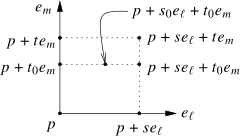
A diagram in a plane with a point p marked. A horizontal arrow to the right is labeled with e sub ell, and a vertical arrow up is labeled with e sub m. The point p plus s times e sub ell is marked on the horizontal arrow. On the vertical arrow, we have a point p plus t times e sub m and below it the point p plus t sub 0 times e sub m. Above p plus s e sub ell and to the left of p plus t times e sub m we have a point p plus s times e sub ell plus t times e sub m. Above p plus s e sub ell and to the left of p plus t sub 0 times e sub m we have a point p plus s times e sub ell plus t sub 0 times e sub m. Finally, between the points p plus t sub 0 times e sub m and p plus s times e sub ell plus t sub 0 times e sub m is the point p plus s sub 0 times e sub ell plus t sub 0 times e sub m.
Figure 8.14. Using the mean value theorem to estimate a second order partial derivative by a certain difference quotient.

See Figure 8.14. The s0s_0 and t0t_0 depend on ss and t,t\text{,} but 0<s0<s0 < s_0 < s and 0<t0<t.0 < t_0 < t\text{.} Let the domain of the function gg be the set (0,ϵ)×(0,ϵ)(0,\epsilon) \times (0,\epsilon) for some small ϵ>0.\epsilon > 0\text{.} As (s,t)∈(0,ϵ)×(0,ϵ)(s,t) \in (0,\epsilon) \times (0,\epsilon) goes to (0,0),(0,0)\text{,} the point (s0,t0)(s_0,t_0) also goes to (0,0).(0,0)\text{.} By continuity of the second partial derivatives,
lim⁡(s,t)→(0,0)g(s,t)=∂2f∂xℓ∂xm(p).\begin{equation*} \lim_{(s,t) \to (0,0)} g(s,t) = \frac{\partial^2 f}{\partial x_{\ell} \partial x_m}(p) . \end{equation*}
Now reverse the roles of ss and tt (and ℓ\ell and mm). Use the mean value theorem on the function σ↦f(p+σeℓ+tem)−f(p+σeℓ)\sigma \mapsto f(p+\sigma e_{\ell} + te_m)-f(p + \sigma e_{\ell}) to find an s1∈(0,s)s_1 \in (0,s) such that
f(p+seℓ+tem)−f(p+seℓ)−f(p+tem)+f(p)s=∂f∂xℓ(p+s1eℓ+tem)−∂f∂xℓ(p+s1eℓ).\begin{equation*} \begin{aligned} & \frac{f(p+ se_{\ell} + te_m )- f(p+s e_{\ell}) - f(p+t e_m)+f(p)}{s} \\ & \qquad \qquad \qquad \qquad = \frac{\partial f}{\partial x_{\ell}}(p + s_1 e_{\ell} + t e_m) - \frac{\partial f}{\partial x_{\ell}}(p + s_1 e_{\ell}) . \end{aligned} \end{equation*}
Find a t1∈(0,t)t_1 \in (0,t) such that
∂f∂xℓ(p+s1eℓ+tem)−∂f∂xℓ(p+s1eℓ)t=∂2f∂xm∂xℓ(p+s1eℓ+t1em).\begin{equation*} \frac{\frac{\partial f}{\partial x_{\ell}}(p + s_1 e_{\ell} + t e_m) - \frac{\partial f}{\partial x_{\ell}}(p + s_1 e_{\ell})}{t} = \frac{\partial^2 f}{\partial x_m \partial x_{\ell}}(p + s_1 e_{\ell} + t_1 e_m) . \end{equation*}
So g(s,t)=∂2f∂xm∂xℓ(p+s1eℓ+t1em)g(s,t) = \frac{\partial^2 f}{\partial x_m \partial x_{\ell}}(p + s_1 e_{\ell} + t_1 e_m) for the same gg as above. As before,
lim⁡(s,t)→(0,0)g(s,t)=∂2f∂xm∂xℓ(p).\begin{equation*} \lim_{(s,t) \to (0,0)} g(s,t) = \frac{\partial^2 f}{\partial x_m \partial x_{\ell}}(p) . \end{equation*}
Therefore, the two partial derivatives are equal.