Reading guide · Proof index

Open and closed sets

Jiří Lebl, Basic Analysis I–II, version 6.3. Free author edition of this section. Selection and attribution · Notation.

L7.2.6: Open unions and finite intersections

Proof.

The sets ∅\emptyset and XX are obviously open in X.X\text{.}
Let us prove ii. If x∈⋂j=1kVj,x \in \bigcap_{j=1}^k V_j\text{,} then x∈Vjx \in V_j for all j.j\text{.} As VjV_j are all open, for every jj there exists a δj>0\delta_j > 0 such that B(x,δj)⊂Vj.B(x,\delta_j) \subset V_j\text{.} Take δ≔min⁡{δ1,δ2,…,δk}\delta \coloneqq \min \{ \delta_1,\delta_2,\ldots,\delta_k \} and notice δ>0.\delta > 0\text{.} We have B(x,δ)⊂B(x,δj)⊂VjB(x,\delta) \subset B(x,\delta_j) \subset V_j for every jj and so B(x,δ)⊂⋂j=1kVj.B(x,\delta) \subset \bigcap_{j=1}^k V_j\text{.} Consequently the intersection is open.
Let us prove iii. If x∈⋃λ∈IVλ,x \in \bigcup_{\lambda \in I} V_\lambda\text{,} then x∈Vλx \in V_\lambda for some λ∈I.\lambda \in I\text{.} As VλV_\lambda is open, there exists a δ>0\delta > 0 such that B(x,δ)⊂Vλ.B(x,\delta) \subset V_\lambda\text{.} But then B(x,δ)⊂⋃λ∈IVλ,B(x,\delta) \subset \bigcup_{\lambda \in I} V_\lambda\text{,} and so the union is open.

L7.2.9-open: Only the complete open-ball half; closed-ball half is P6.4-ball

Proof.

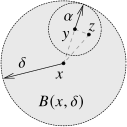
Let y∈B(x,δ).y \in B(x,\delta)\text{.} Let α≔δ−d(x,y).\alpha \coloneqq \delta-d(x,y)\text{.} As α>0,\alpha > 0\text{,} consider z∈B(y,α).z \in B(y,\alpha)\text{.} Then
d(x,z)≤d(x,y)+d(y,z)<d(x,y)+α=d(x,y)+δ−d(x,y)=δ.\begin{equation*} d(x,z) \leq d(x,y) + d(y,z) < d(x,y) + \alpha = d(x,y) + \delta-d(x,y) = \delta . \end{equation*}
Therefore, z∈B(x,δ)z \in B(x,\delta) for every z∈B(y,α).z \in B(y,\alpha)\text{.} So B(y,α)⊂B(x,δ),B(y,\alpha) \subset B(x,\delta)\text{,} and so B(x,δ)B(x,\delta) is open. See Figure 7.6.

A shaded disc with a dotted boundary of radius delta is centered at x and labeled as B of x comma delta. There is another disc that lies completely inside the bigger disc touching its boundary from the inside and is centered at y and is of radius alpha. A third point z is inside the smaller disc. The points x, y, and z give a dashed triangle.
Figure 7.6. Proof that B(x,δ)B(x,\delta) is open: B(y,α)⊂B(x,δ)B(y,\alpha) \subset B(x,\delta) with the triangle inequality illustrated.

The proof that C(x,δ)C(x,\delta) is closed is left as an exercise.

L7.2.19: Closure is closed and contains the set

Proof.

The closure is an intersection of closed sets, so A‾\widebar{A} is closed. There is at least one closed set containing A,A\text{,} namely XX itself, so A⊂A‾.A \subset \widebar{A}\text{.} If AA is closed, then AA is a closed set that contains A.A\text{.} So A‾⊂A,\widebar{A} \subset A\text{,} and thus A=A‾.A = \widebar{A}\text{.}

L7.2.22: Every ball about a point of the closure meets the set

Proof.

Let us prove the two contrapositives. Let us show that x∉A‾x \notin \widebar{A} if and only if there exists a δ>0\delta > 0 such that B(x,δ)∩A=∅.B(x,\delta) \cap A = \emptyset\text{.}
First suppose x∉A‾.x \notin \widebar{A}\text{.} We know A‾\widebar{A} is closed. Thus there is a δ>0\delta > 0 such that B(x,δ)⊂A‾c.B(x,\delta) \subset \widebar{A}^c\text{.} As A⊂A‾A \subset \widebar{A} we see that B(x,δ)⊂A‾c⊂AcB(x,\delta) \subset \widebar{A}^c \subset A^c and hence B(x,δ)∩A=∅.B(x,\delta) \cap A = \emptyset\text{.}
On the other hand, suppose there is a δ>0\delta > 0 such that B(x,δ)∩A=∅.B(x,\delta) \cap A = \emptyset\text{.} In other words, A⊂B(x,δ)c.A \subset {B(x,\delta)}^c\text{.} As B(x,δ)c{B(x,\delta)}^c is a closed set, as x∉B(x,δ)c,x \not \in {B(x,\delta)}^c\text{,} and as A‾\widebar{A} is the intersection of closed sets containing A,A\text{,} we have x∉A‾.x \notin \widebar{A}\text{.}